
America at 250


Greetings and welcome to a Fourth of July edition of The Sunday Morning Post. If you’re reading this on the weekend it is being published, it’s an exciting time here in the United States, as we celebrate our semisesquicentennial. I’m reminded of the Mark Twain quote, “Don’t use a five-dollar word when a fifty-cent word will do,” but you only get so many chances to use “semisesquicentennial” in its proper context, so there you have it.
The truth is, I’ve actually been looking forward to this day since I was a child. I remember doing the math on 1776 and wondering if I would be alive on the occasion of the nation’s 300th birthday in 2076, (here’s hoping), but then calculating out that 250, which is a big milestone itself, was already within sight. And here we are!
I have always loved the Fourth of July, for all the traditional reasons you might think of. Parades, picnics, popsicles, fireworks, people coming together: what’s not to love? The Fourth of July was also my grandmother’s birthday, and that always felt particularly special (and her husband, my grandfather’s, was July 6th!). Actually, it’s still a big birthday time in our family — although my grandparents have passed, my wife, daughter, and I all have birthdays coming up in the next two weeks. July is a great birthday month.
All in all, I put the Fourth of July on even par with Christmas and Thanksgiving as my favorite holidays. But this year, despite the rosy and patriotic feelings I generally have for this truly American holiday and for all of the anticipation about the semisesquicentennial, this year’s celebrations feel underwhelming, at least for something as consequential as a 250th birthday party.
Today’s article is not going to be some grand treatise on the state of affairs here in the United States of America. I honestly wish I had the bandwidth and intellectual fortitude to write that piece right now, but I don’t. Maybe someday. It would probably need to be its own series. But I did want to share some thoughts on America at 250 as it feels like it would be a missed opportunity for the semisesquicentennial to pass without some Sunday Morning Post commentary.
How Did We Get Here?
There is a line in the Hamilton Cabinet Battle #1 song where the Thomas Jefferson character raps, “Life, liberty, and the pursuit of happiness. We fought for these ideals, we shouldn’t settle for this.” That line has been ringing in my ears off and on for, well, the past few years, but especially the past few weeks watching this country get ready for the Fourth of July. It just seems like things should be better — more fun, more exciting, more celebratory, and less dark — for something as significant as our country’s 250th birthday. The lasting image of this year’s celebration will probably be an algae-filled reflecting pool, or perhaps the UFC claw stage set up on the White House lawn. The fireworks in Washington D.C. were probably great last night (I wasn’t home to watch them), but the overall event has been marred by questionable attendance, dire heat, and the virtual politicalization of everything. On the one hand, people are upset that certain states (including Maine!) didn’t sent representation to the Great State Fair of America, while on the other, people are upset that much of the celebrations in nation’s capital have turned into a self-reverential shrine to one particular guy. You know who I’m talking about. And it’s not George Washington.
Americans are not feeling particularly good about their country these days. American pride is at a record low, with a Gallup poll out just this week saying that a mere 33% of U.S. adults are “extremely proud” to be an American, which is the lowest mark since the poll began in 2001. In a Pew poll, almost 6 in 10 Americans think the country’s best days are behind us. Majorities of both Democrats (64%) and Republicans (53%) feel this way, although they undoubtedly feel pessimistic for different reasons. A similar poll from the Associated Press and National Opinion Research Center found that 72% of Americans believe things are generally headed in the wrong direction. A majority of people believe the United States will be worse off in 2050 than it is today. The AP poll also showed 66% of Americans disagreeing with the statement “if you work hard, you’ll get ahead.” So much for the American Dream.
The Founders’ Forgotten Insight
The list of ways we have gone astray as a nation could fill many digital pages, and indeed, you can find that content all over the internet. I want to bore down on just one of them today. One of the biggest changes over the last century of American politics has been structural. The Founders intentionally designed a government that dispersed power. Today, we've done almost the opposite. Presidents of both parties have steadily accumulated authority that once belonged to Congress or the states, leaving the White House at the center (and the top) of nearly every national debate.
The American Revolution was the most impactful political event in human history, and we mostly see it through a lens of a plucky, upstart nation throwing off the yoke of oppressive royal power and launching the great democratic experiment. This is all true, but the other beautiful thing about the founding of the United States was that the Founders purposely set up a government of co-equal branches with checks and balances between the three. The enlightened idea behind this was to spread power out so that no one branch (or, perhaps more importantly, no one person) would have too much control. The Founders recognized the notion that power corrupts, and they intentionally designed a system of shared power with checks and balances so that power would be spread out and limited.
The Founders have been beaten up a bit in recent years, with various historians, intellectuals, and advocates pointing out the obvious flaws in the premise of a concept that All Men are Created Equal being espoused by men who were slaveholders at the time. The simple but profound phrase by definition excluded women, of course, too. And the Colonists’ displacement and ravaging of Native American societies has gained increasing credence and understanding in recent years, too.
This is all, in my opinion, fair and appropriate. History is complicated. The human beings that have been the main characters of history are just that — human and imperfect. I welcome a more inclusive (and accurate) telling of American history.
But I feel there has also been an inflection point in the way we teach U.S. history, and the Founders are being judged more for these faults than for the cataclysmic changes they brought to the world order and, indeed, the freedom of humanity for generations to come. I don’t think we should throw out the good when pointing out the flaws. So I will always admire and appreciate the Founders for the brazen act of revolution and the subsequent and, indeed, revolutionary process in its own regard of establishing the system of American government that endures to this day. I look at the beliefs, behaviors, and principles of the Founders in the context of their time. I think we should address the complexity, but also appreciate how truly special the founding of the United States was in its historical context.
So even acknowleding their flaws (and they were real) the Founders left behind an enduring political insight: power should be divided because of the very fact that human beings are imperfect. We are greedy, vengeful, proud, prone to hysteria, and all the rest. And it was for those reasons that they didn’t design a system around trusting just one leader, or even a small group of leaders; they designed a system around limiting them.
What About Today?
While “life, liberty, and the pursuit of happiness” is the headliner from the American Revolution, it was also this notion of checks and balances that was such a revolutionary concept. But we are a far cry from that notion today. Presidents from both parties over the course of time have significantly increased the power and influence of the Executive Branch of government, so much so that the “United States government,” is often thought of as the White House itself (and its occupant), with Congress and the Courts playing a secondary, lesser role.
Consider just one example: the Founders knew that wars could not only be heavily destructive to a country and its people, particularly one as young and vulnerable as the United States at the time, but they were expensive and could mark true inflection points for the nation. Given the grand scale of the decision to go to war and its consequences, the Founders specifically gave the power to declare war to Congress, and not the President. The President is the Commander in Chief, and so dictates the organization of the military and its activities once war has been declared (itself a check and balance on power), but only Congress was meant to declare war. James Madison said on the topic:
The Constitution supposes, what the History of all Governments demonstrates, that the Executive is the branch of power most interested in war, and most prone to it. It has accordingly with studied care vested the question of war in the Legislature.
But what is the modern stance on this? Almost exclusively, the ability to wage war (with some nuance behind the definition of what it means to “declare” war) has rested with the President. The obvious current example is that of the Iran War, which has been unpopular here in the United States, and which was not approved by Congress (although Congress did subsequently approve funding), and which the President seemingly executed without consulting Congressional leaders ahead of time. Congress was then left with the awkward question of voting to limit President Trump’s war powers during a war that was already going on. It was a bad look all around for the United States, in my opinion.
But while it would be easy to just point a finger at President Trump on this one (and, indeed, he has done a lot to consolidate power into the Executive Branch), Congress has not actually declared a single war since World War II. The Korean War, the Vietnam War, the Gulf War, the Global War on Terrorism including Iraq and Afghanistan and more recently in Libya, Yemen, Syria, and against Isis around the world: none of these have featured formal declarations of war by Congress. There has been a modern sidestepping of the traditional war declaration called an Authorization for Use of Military Force (AUMF) that Congress has offered to the president in many of these circumstances, and these AUMF’s are now central questions in debates on who truly gets to initiate wars with other countries, groups, or territories. At best, it’s political disagreement. At worse, it’s an ongoing Constitutional crisis.
Proponents of executive power would say modern warfare has changed so much since the time of the Founders that the president needs to have some ability to respond to global crises quickly without needing to wait for the full legislative process to unfold. Regardness of this fair concern in certain circumstances, it’s clear we are well far astray from what the Founders originally intended on the topic of war powers. At the core, the Executive Branch has seized power from the Legislative Branch and, indeed, the Legislative Branch has essentially abdicated its own responsibilities to act as that check and balance.
War powers are just one area where this syphoning of power has taken place, and, indeed, it is one of the most consequential. But there are other areas, too, including ones in which the Executive Branch has taken power from the Courts, or where the Courts have taken power from Congress and vice versa. Again, this could all fill a book.
So What Is to Be Done?
The scope of what needs to happen to correct the messes in Washington is well beyond this week’s article. It’s almost overwhelming to think about. The fact that there are so few Congressional districts that are actually in-play as toss-up election seats, for example, is one part of the problem. Probably about 90% of the seats in Congress are either “safe Republican,” or “safe Democrat,” so whoever wins the party primary in both cases is almost assured of winning the general election. This creates a skewing of candidates to their respective bases as they strive to defeat a fellow Republican or a fellow Democrat by outflanking them to the more extreme ends of the spectrum in appealing to partisan blocs of primary voters.
It may sound trite, but what is actually within all of our scopes to address is the way we ourselves interact with one another and with our elected leaders. The concentration of power in Washington has been accompanied by a concentration of our attention. Every day, millions of Americans wake up and immediately immerse themselves in political battle lines in their Facebook feeds. We know the names of cabinet secretaries but not the members of our town council. We can explain yesterday’s controversy on Facebook but couldn’t tell you who organizes the local food pantry or serves on the school committee. Every crisis, every outrage, every political battle is carried around in our pockets and is fed directly into our consciousness by algorithms that enhance agitation, anger, and distrust by design. We spend hours emotionally invested in arguments occurring hundreds or thousands of miles away while knowing less and less about the people who live a few blocks from us.
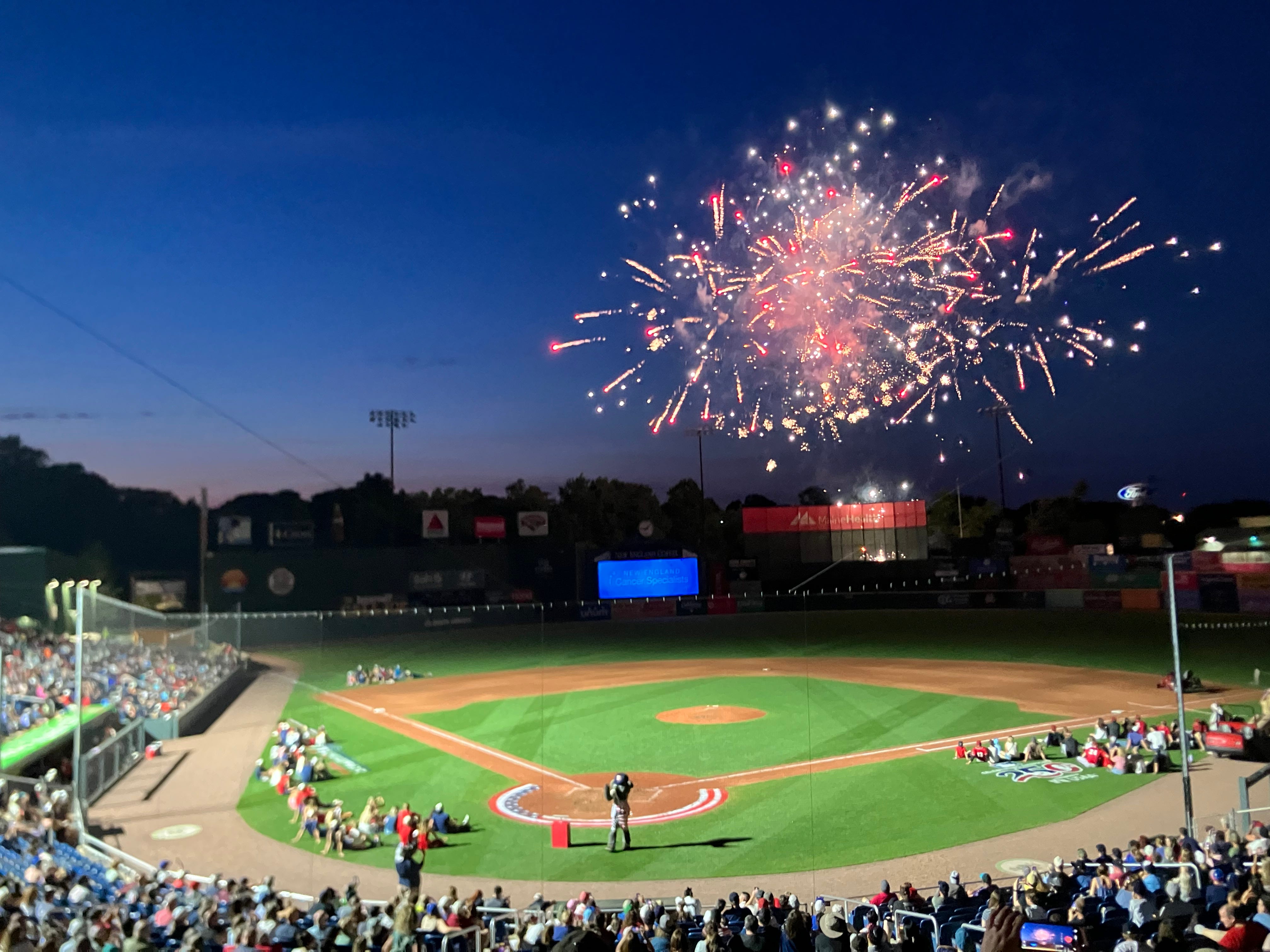
Despite the negative feelings throughout this week’s piece and my glum feelings about Independence Day this year, it actually turned out to be a good day. But I didn’t turn on the TV once, and barely opened the internet, let alone Facebook or Instagram. Two of my kids and I ran in our local 3K road race along the Fourth of July parade route before the parade began, and then later in the day we went to a Portland Sea Dogs baseball game, which was followed by fireworks. It was a great day after all.
And maybe that is the answer: to focus more inwardly on a smaller and more local scale. It’s a privilege to be able to check out of national politics. Not everyone can. But for many people, the solution for what ails us is not more Washington D.C., but more Downtown Bangor, or Main Street (wherever you live), or more baseball fields with friends and neighbors. It’s screen-free neighborhood picnics instead of an evening on the couch scrolling through algorithm-chosen feeds. It’s church bean suppers instead of eating alone.
Maybe that is one lesson worth remembering on America’s 250th birthday. The Founders certainly believed in national institutions. But they also believed in local ones. They expected citizens to participate in town meetings, churches, civic organizations, volunteer fire departments, newspapers, schools, charities, and neighborhoods. It was probably understood as a prerequisite that if the national government was going to be viable and successful, it was meant to rest on a foundation that included a citizenry that was highly engaged with the local fabric of their towns, regions, and states.
So maybe as we begin our next 250 years, we should strive to know our neighbors better, who are undoubtedly more reasonable than the caricatures and stereotypes we see of one another online. Coach a team. Join a service club. Volunteer at your library. Attend a town council meeting. Eat at the diner or the church pot luck instead of the drive-thru. Go watch your local parade. And have faith that the country will endure, and that we will continue to slowly but surely work towards that more perfect union, even if things seem not quite as celebratory on this semisesquicentennial as they should be.
Here is something to ponder on that relates directly to the difference between what excited people 250 years ago and today: https://peeta462032.substack.com/p/usa-250-the-word-the-founding-fathers.
John Locke wrote that every person has a natural right to life, liberty and estate. When Jefferson drafted the Declaration, estate disappeared. In its place came the pursuit of happiness.
Thomas Paine argued that the earth, in its natural state, was the common property of the human race. Cultivation had made land productive, but it had also, necessarily, dispossessed everyone who did not hold title to it. Paine proposed a national fund, paid for by landowners as a form of ground rent on the value they had monopolised, which would pay every citizen a lump sum on reaching adulthood, and a pension in old age. Not charity. Compensation, owed as a matter of justice, for the enclosure of what had once belonged to everyone. In compensation for the loss of their 'estate'.
A lump some on reaching adulthood could allow the purchase of a house, ones estate, without which its not possible to settle down with a mate and raise children.
John Locke, Adam Smith and Thomas Paine were of like mind in this respect.
I like your work, Ben, and have read your posts since pre-substack/email only days.
But the amount of mental/linguistic gymnastics you go through to not lay the enshittification of Independence Day squarely at the feet of Trump and his followers is surprising and disappointing.
I get it, you're a numbers guy, a financial professional banker/bankster - which lends itself to fiscal conservatism and thus, Republicanism. But damn, brother, you're dancing all around the source of the problem while discussing it at length.
I further understand you don't want to alienate or offend part of your readership, but if you have to elide the truth like this, throwing your hands up and wishing it were different, without ever naming Trump and his crony ilk, then why bother broaching the subject in the first place.
Be well, Ben. Thanks for your other writings.