


A question to start out this week’s article: considering some of the major overarching cultural and societal trends over the past twenty years, would you expect the portion of Americans who move each year to be steadily increasing or steadily declining?
I would have said increasing, but I came across a statistic this week that showed exactly the opposite: the number of movers has been on an almost perfect trend downward since 2006, per data from the U.S. Census Bureau:
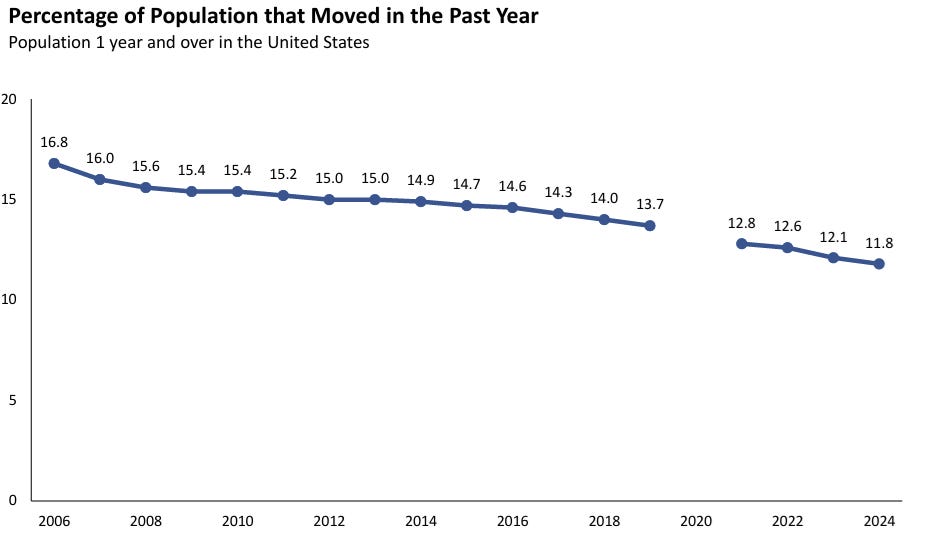
The numbers mean that in 2006 about one out of every six Americans moved in a year. By 2024? Only one out of every eight and a half, give or take. Statistics were not kept during the pandemic, which is why those years are blank.
The trend comes despite the rise of remote work. With technology and more lax attitudes about being in the office, many people can now do their work from anywhere. Digital nomadism is a major cultural trend. Why stay anchored to one spot, many people are asking themselves, when you can move from place to place.
Moreover, as the cost of living continues to increase, people are moving to more rural areas purely as a cost-of-living play. We have definitely seen this here in Maine, which has seen a rare influx of new residents over the last five years. This was partially because Maine was perceived as a particularly safe place to be during the pandemic, but it is also for the relatively low cost of living and lower real estate values as compared to other parts of the country (although, to be sure, parts of Maine are very expensive, particularly in the Portland area and along the coast).
Another reason to suspect more people are moving: this is only anecdotal and perhaps not a true trend, but in this hyper-partisan world in which we live, I have seen anecdotal evidence of people moving to cities and states where the political ethos more closely matches their own. This has been conservatives moving from politically and culturally blue areas of the country to the Sunbelt South, or, on the opposite side of this coin, progressives moving from culturally and politically conservative areas to bigger cities and more liberal states in the Northeast and West. At some point, I feel like we are going to have two fully separate countries-within-the-country, blue and red…if we don’t already.
Why Aren’t People Moving?
So, despite the hypotheses above suggesting more internal mobility from area to area of the country than perhaps there has been, why aren’t people moving as often anymore? I see several main reasons. First, and well-documented in previous editions of The Sunday Morning Post, is the interest rate lock-in effect. People with pre-2023 mortgages, often with rates of 3.0% or better, are reluctant to give those up. Not only would they be borrowing at a higher interest rate, but home prices have risen significantly throughout the country over the past few years, so would-be movers would be hit twice on the math: a higher cost of borrowing and a higher home price to boot.
Yet the lock-in effect has been especially relevant only in the last few years. The trend away from moving has been a reality for 20+ years. And, in fact, the trend is multigenerational (far surpassing the recent lock-in effect). In 1948, the first year the U.S. Census Bureau started tracking this data, the percentage of American movers was 20.2%. The portion remained at about the same level for much of the next 20 years, hitting a high-water mark of 21.6% in 1956, before beginning its steady decline into the teens and low-teens over the course of the next 50+ years. In other words, people have been moving less since 1948.
It’s Expensive to Move
A second reason why moves have declined is that it is, simply put, expensive to move. The cost of building a home has increased significantly over the past 60 years (including, especially, the last 10 years!). Homes are bigger and have more features, and the cost of materials and labor is higher, even on an inflation-adjusted basis. And the cost of buying an existing home is expensive, too. I don’t have any data on the costs of moving, but I imagine since we have more stuff this day in age, it’s more expensive to move all of it (e.g. hiring a company, the cost of trucks and labor, etc.). Real estate transaction fees including commissions, title insurance, and the like are also all much higher than they were 40+ years ago. With people living closer to the line today, the high costs to move are a powerful disincentive. Renters, too, face higher costs of moving, including application fees and more significant deposit requirements as they move from apartment to apartment.
Industry Clusters
I have believed that the rise of remote work will make people move more, but there are two countertrends working against that argument. The first is that if you do work in a job where you can work remotely, that is actually a disincentive to move. In times past, if you worked in the corporate office of a large industrial firm, they might move you to different area of the country several times based on the evolving labor and management needs of the company. But instead, perhaps now with the ability to do much of that work remotely, you can live in a smaller, lower cost community and use that spot as a long-term base of operations — all the better if it’s a place that has a local or regional airport that gives access to the world when needed.
The second, related point is that industries often cluster in geographic areas, making moves less necessary. For all the global impact of the tech industry, for example, it is still very much centralized in Silicon Valley, New York City, and some smaller hubs like Austin, Texas. If you’re a tech industry insider switching between companies, you may not actually need to make a geographic (and therefore, a housing) move.
People Get Old
Another factor at play is that America is aging. Per the U.S. Census Bureau:
Between April 2020 and July 2024, the median age rose in 329 of the nation’s 387 metro areas. At the same time, 47 metro areas experienced a decline in median age — many of which were in the South, including some in Florida.
The median age across the country today is about 39 years old. The median age has risen steadily and incrementally from an age of 28.1 in the 1970s, as shown in the chart below via Statista:
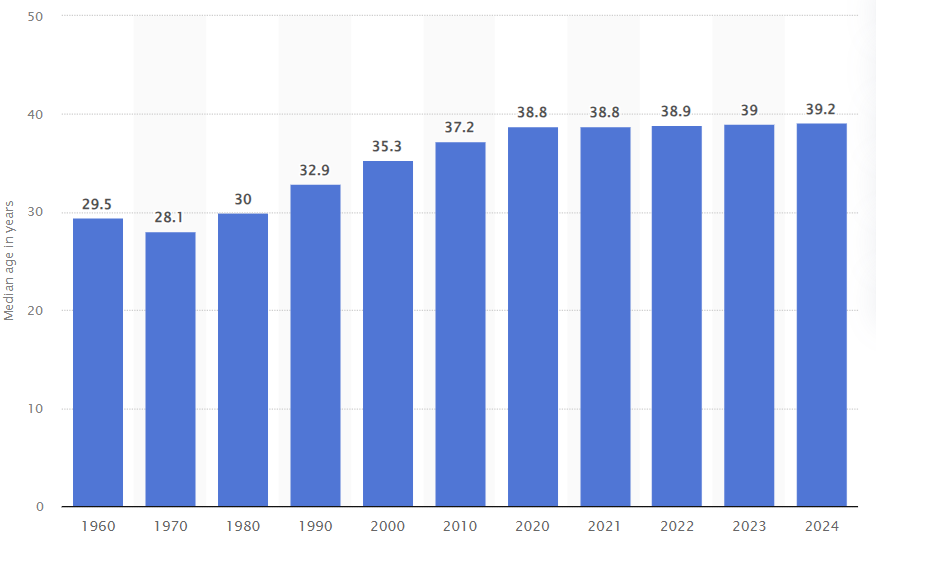
People are living longer and having fewer kids, which is an easy formula for a rising average age. Older people don’t move as frequently as younger ones do, which makes this a powerful variable that helps to explain the decline in moves. The decline might therefore be explained by demographic evolution rather than shifting choices.
A Final Thought
I believe another reason for the decline in moves is that America has experienced a trend towards risk aversion. People are not making big career jumps or significant geographic moves, in part, because they don’t want to absorb the risks that come with the uncertainty of a major life decision like that. Our systems of health insurance, retirement benefits, and other perks are so closely tied to traditional W2 employee jobs, which makes the idea of taking any sort of risk or entrepreneurial leap feel especially risky. The result is employment stasis, or at least hard inertia against making any sort of big moves, career-wise or geographic. For a country built on risk takers and rugged individualism, we sure do have a lot of people staying in jobs for their health insurance.
A related point is that people just don’t make big life decisions (such as to change jobs, buy or sell a home, or change geographies) when they are feeling economically uncertain or anxious. Although the economy has had its ups and downs over the last 20 years (let alone the last 70+ years), I would argue that American anxiety in general has been on a steady escalating clip over this time period. We are generally more anxious and collectively more stressed. This is the case for any one of a number of reasons, all of which could fill their own Substack series. General income inequality and the rising gap between the haves and the have-nots, emotional disequilibrium that comes from the bombardment of stimuli from constant screens, anxiety from social media addiction, the perils, evils, and dangers of the world being constantly streamed at us at a clip our brains cannot handle: there is a lot being thrown our way. Maybe it is possible that it is all just wearing us down, hence delaying or disrupting our energy and initiative to make big life decisions, like whether to move.
In the end, it’s probably a little from all of the aforementioned columns: the nation is creeping older, it is expensive to move and many people don’t have a lot of extra money for such things these days anyway, and shifts in workplace culture have allowed people to settle down in one place rather than move from, say, Scranton to Nashua to Stamford, Connecticut at your medium-sized regional paper company. And, yes, Americans, I believe, are increasingly boxed in by the anxieties of life, more and more uncomfortable with risk, or simply too tired to make big moves. Those are bigger problems, beyond the scope of today’s look at the multi-decade decline in moves.
Ben Sprague lives and works in Bangor, Maine as a Senior V.P./Commercial Lending Officer for Damariscotta-based First National Bank. He previously worked as an investment advisor and graduated from Harvard University in 2006. Ben can be reached at ben.sprague@thefirst.com or bsprague1@gmail.com.
Have a great week, everybody!
I think the rise of remote work makes a lot of sense why people aren’t moving more. I have been a remote worker since 2016 yet have changed companies 4 times. Prior to working remotely in my professional career, job changes were always accompanied by a move - now, they aren’t.
Ben, under the heading of the stresses of life, I will add the concern that many have for job security. Just watching so many federal employees lose their jobs at the whim of a billionaire and the tumultuous discussions of what AI has done to starting positions for young graduates and certain professions such as law and journalism, the news makes many revert back to safety: if you have a job, you had better stay there.