


It’s been a slower summer construction season around the country over the past few months, at least compared to previous years and compared to what the summer building months should normally look like. New single-family home starts were running at a seasonally adjusted, annualized rate of 808,000 in July, which was down about 10% from a level of 897,000 in June and down about 20% from a level of 1.017 million in March. Starts were also down year-over-year compared to last July by about 16%.
Below is what the chart looks like over the past 10 years. You can see a sharp drop in new home construction right when the pandemic began, followed by a year-long surge, attributable to low interest rates, COVID-related movements of people around the country, and inward-facing behavior by people who were suddenly spending a lot of time at home:
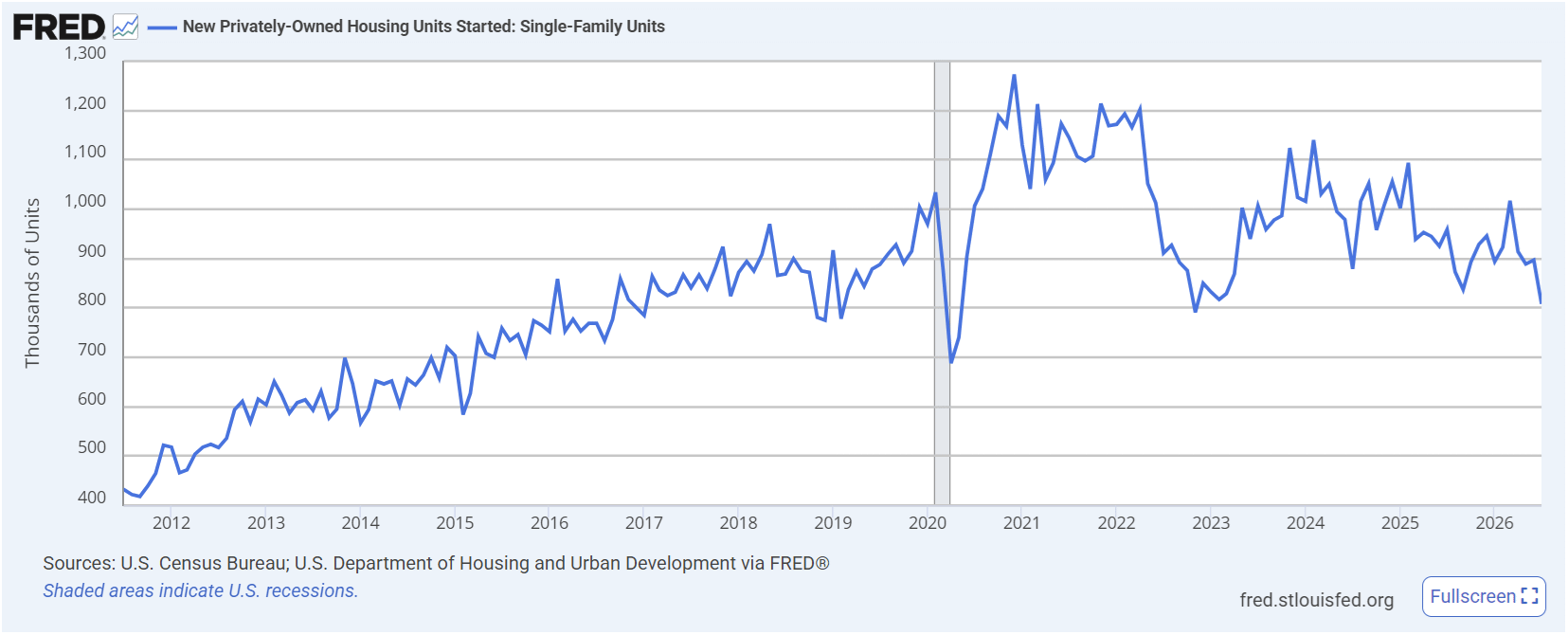
Single-family new home construction has essentially been on the decline for four years and is lower today than the level at which you might expect it to be if normal trends prior to 2020 had continued. If growth in home construction had continued on the trend it was on from 2011-2020, the pace of new home construction would be roughly 1.2 million per year today; we are far below that, however.
Construction starts on the multifamily/rental side of things are going in a similar direction: multifamily starts were 421,000 in July, down about 16% from June and about 7% year-over-year. Combined, the two statistics show a damp construction market, particularly in recent months.
Why the Decline?
In a time when it is so hard for many people to find a home and elevated rents continue to be a problem, you might expect new home construction, including rental properties, to be rising, not falling. So what’s going on?
The National Association of Home Builders does a monthly survey to track builder sentiment, which offers some clues as to why construction has been on the decline this summer. Quick trivia: the survey calculates sentiment on a 0-to-100 scale, with 0 being the worst and 100 being the best. The all-time low was a reading of 8 in January 2009 during the depths of the financial crisis. The all-time high was November 2020, with a reading of 91. Even though this was practically the peak of the COVID-19 pandemic, roaring demand amid rock-bottom interest rates made for a robust home construction market.
Sentiment today is low by historical standards, with a reading of 35. This is on par with previous recent months, but down from historical averages in the 50–65 range. There are some regional differences in today’s data: readings are 44 and 45 in the Northeast and Midwest, respectively, and just 31 and 27 in the South and West, reflecting a particularly pessimistic feel to things in those parts of the country, at least as far as homebuilders are concerned.
Builder sentiment surveys and other data suggest three primary reasons for the construction slowdown.
Interest rates: We tend to think about high interest rates in housing primarily from the perspective of the buyer. A 30-year mortgage rate above 6% makes a house considerably more expensive to own than it was when mortgage rates were around 3% a few years ago, this is clear. Higher rates reduce the pool of potential buyers and makes builders less confident that they can sell the homes they build, so fewer homes are built.
But interest rates affect builders, too. Developers generally borrow money to acquire land, prepare lots, and finance construction before a house is sold. When those borrowing costs rise, the economics of a project become less attractive. A builder can absorb some of that additional cost, pass it along to the eventual buyer, or simply decide not to build. With buyers already stretched by high mortgage rates and home prices, passing along higher costs becomes increasingly difficult.
The cost and availability of building materials: The inflation story didn’t end when the overall inflation rate came down from its 2022 peak. The price of residential building materials was about 5% higher in July than it was a year earlier, the largest annual increase since late 2022. Lumber prices alone are up more than 17% from a year ago.
Tariffs add another layer to the problem. Home construction relies on everything from Canadian lumber to steel, aluminum, appliances and other imported products or products containing imported components. Tariffs and duties can raise those costs directly, while uncertainty about future trade policy can make it harder for builders and suppliers to know what materials will cost six months from now.
Just as with the cost of higher interest rates, builders can theoretically pass higher material costs along to buyers. But there is a limit to how much buyers can afford, particularly when they are already dealing with higher expenses in other areas. Eventually, some projects simply stop making financial sense, so they do not take place.
Economic uncertainty: The third factor is harder to quantify, but probably just as important. Buying a house is one of the biggest financial decisions most people ever make. People are generally less inclined to make those big decisions when they are uncertain about the future. A prospective homebuyer who is worried about his or her job may decide to renew a lease for another year. A family that thinks mortgage rates are too high but might be lower in the future could wait six months before undertaking their project. A developer uncertain about future interest rates, tariffs, material prices or the broader economy may postpone the next phase of construction of a group of homes or multiunit apartments.
That hesitation feeds on itself. When fewer buyers are walking through model homes, builders become more cautious about starting new ones. In this month’s NAHB sentiment survey, foot traffic in showings was reported as down, and 35% of builders reported cutting prices while 63% indicated the use of some form of sales incentives. Those aren’t exactly signs of a market in which builders are eager to ramp up production.
What It Means for the Economy…and the Housing Market
By some estimates, new home construction and related residential investment represent about 4% of GDP. That might not sound like a lot, but it represents well over $1 trillion in economic activity. Every house that is built generates not only income for the homebuilder and contractors who work on that house, but also revenue for material providers, appliance stores, banks, real estate agents, title companies, and perhaps a dozen or more other people and companies connected with the construction and sale of a new home. When the rate of construction slows down, it has a dampening effect throughout the economy.
In fact, there is pretty good evidence that a decline in new home construction can be a leading indicator of an economic recession. Consider the chart below, which shows new housing starts for both single-family homes and multiunit properties combined going back to 1959. The vertical gray bars represent periods of economic recession. In many cases, you can see where housing construction starts to decline just a few months before the broader economy enters recession.
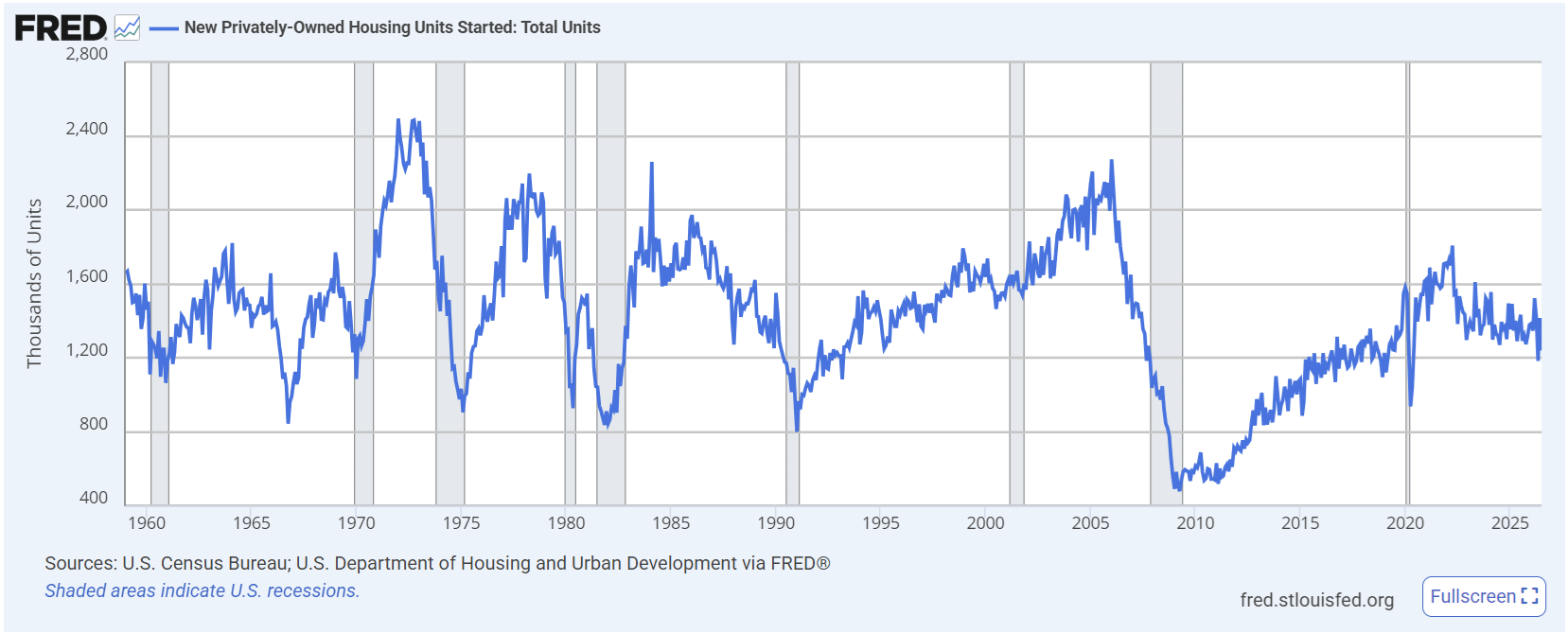
That doesn’t mean every decline in home construction causes or predicts a recession. There have been housing slowdowns without recessions, and there are plenty of other variables that determine the direction of the economy. But housing is particularly sensitive to interest rates and consumer confidence, which is one reason economists pay attention when construction activity starts moving sharply in one direction or the other. The two variables (rate of construction and economic recession) are at least correlated, I think you can fairly say, and it should be interpreted as a worrisome sign for the economy when the rate of new home construction slows the way it has been lately.
The question of the impact on home prices cuts in two directions. On the one hand, the best way to lower prices for beleaguered buyers (especially first-time homebuyers who are just trying to get into the market) would be to have vast amounts of new construction, thereby increasing the inventory of new homes for sale, which could ease price pressures. If the rate of construction slows down, it could diminish the potential for lower prices.
But on the other, as noted in the homebuilder survey, the slowdown is also a reflection of lower demand. Builders are having to implement incentives and are reducing prices to find buyers. That itself is a sign that prices may be easing, which is good news on the buyer side (not so good on the builder side necessarily, though).
What Comes Next
Despite the gloomy take in the article today, there are at least a couple of reasons to think the construction picture could actually improve from here. Building permits, which tend to lead actual construction starts, actually increased in July. Single-family permits rose 2.5% from June, while overall permits were up 5%. That suggests some builders are preparing projects even if they are uncertain about the landscape.
But a sustained rebound will probably require some combination of lower borrowing costs, greater stability in construction costs, and improved confidence among consumers and builders. In the meantime, housing doesn’t determine where the economy is going all by itself. But historically, when homebuilders start getting nervous, it has been worth paying attention.
Ben Sprague lives and works in Bangor, Maine as a Senior V.P./Commercial Lending Officer for Damariscotta-based First National Bank. He previously worked as an investment advisor and graduated from Harvard University in 2006. Ben can be reached at ben.sprague@thefirst.com or bsprague1@gmail.com. Thoughts and opinions here do not represent First National Bank.