
How the Iran War is Affecting Everything


I’ve never wanted The Sunday Morning Post to be a current events newsletter. There are plenty of places you can go to get the economic facts of the week (actually, I’ll share links to some of the resources I use as an addendum at the end of this week’s article). I think I also went about two years in the early days of The Sunday Morning Post barely ever writing the names “Donald Trump” or “Joe Biden” because I didn’t want this to be a series of political articles, and quite honestly it gets exhausting to include the political overlay even though I know it’s often relevant. There are plenty of places you can go to find that type of analysis, though.
But nonetheless, current events have far-reaching impacts, as do the rantings, ravings, and ramblings of whoever is in the White House. Sometimes I think it would all be a lot more interesting if it wasn’t real life. It’s hard to write about interest rates and gas prices when it feels like the world is on fire. This is also the third time I’ve written about Iran lately (here and here), so I wouldn’t blame you for getting tired of the topic, although it really is the thing that touches on all other topics right now.
So we press on. Because actually, interest rates do impact people in significant ways, as does the price of gas, for that matter. I saw and heard anecdotal evidence from some of my business owner bank customers that March was a tough month. People just were not going out and spending money, no doubt burdened by high prices on all manner of goods and services and, in particular, the cost of filling up the tank. When people can’t afford the normal things of life, it doesn’t just have real-world implications — it’s actually the real world.
A Brief History on Oil Shocks
Things are structurally different today than they were in the 1970s, but it’s still worth a quick comparison. In 1973, there was a coordinated cutoff of oil supply by the OPEC nations, which resulted in dramatically higher prices. Prices quadrupled, in fact. A similar supply shock occurred in 1979. The jumps in oil prices sparked economic recessions here in the United States in both 1973-1975 and in the early 1980s. Both recessions were marked by steep increases in inflation and muted economic growth.
The 1970s was not the only period of disruption in the oil market. The price of oil peaked at $147/barrel in June 2008, for example. We all know what happened next: a massive financial crisis more significant than anything since the Great Depression. Oil prices also peaked because of the supply chain crisis during the pandemic. That rise, too, was part of a massive inflationary upswing.
If you look at the chart for the price of oil, you can see just how notable these upswings have been (data is only available from this source going back to 1986, so the oil shocks of the 1970s are not shown):
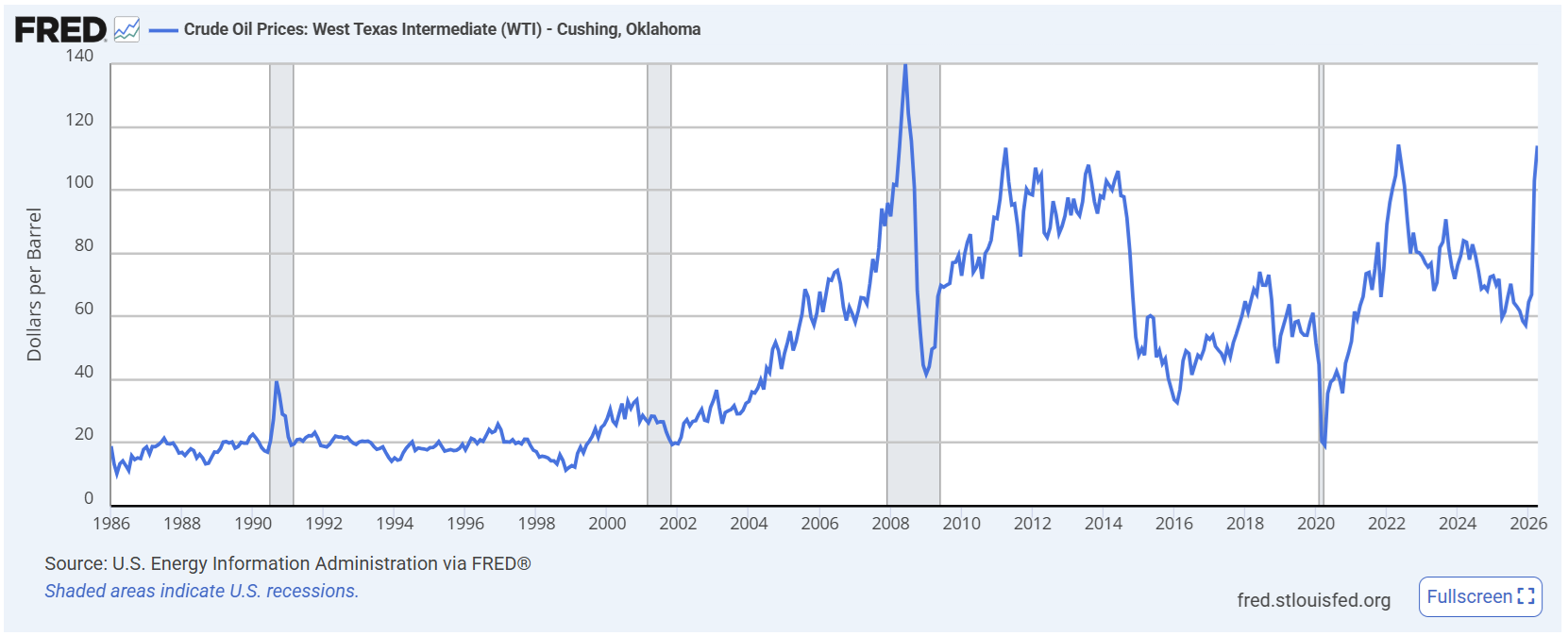
The rapid rise in oil prices over the past 45 days is clearly evident on the far right side of the chart. Almost every other time prices have spiked like that, it has preceded an economic recession, which are all the vertical grey areas of the chart.
Does that mean we are marching towards a recession? It depends on a lot of things, including how quickly, or not, things are resolved in Iran. Certain key data points are flashing red warning signs, though:
The average price for a standard gallon of gas at the pump has increased from $2.93 on February 27th to $4.12, an increase of 41%.
The average 30-year mortgage rate was 5.99% on February 27th, and closed this past week at 6.39%.
The monthly CPI reading jumped from 2.4% in February to 3.3% in March, which is a pretty big move in the wrong direction, and creates some serious headwinds against further interest rate cuts in the months ahead by the Federal Reserve. Early readings on April inflation have it tracking towards 3.6%.
Consumer sentiment has declined in both March and April. Per the University of Michigan report:
Consumer sentiment sank about 11% this month, extending a decline that began with the start of the Iran conflict, and is currently about 9% below a year ago. Demographic groups across age, income, and political party all posted setbacks in sentiment, as did every component of the index, reflecting the widespread nature of this month’s fall.
In fact, Friday’s consumer sentiment report recorded the lowest reading… ever. “Open-ended comments show that many consumers blame the Iran conflict for unfavorable changes to the economy,” said Joanne Hsu, the survey’s director, as part of the data release.
What Happens Next?
I’m not a Trump whisperer by any means, and needless to say it is hard to predict what he is going to do or say. But I know he must care about the political realities of the current moment. We are headed for crucial mid-term elections this fall, and Democrats are poised to make big gains regardless of what happens with the crisis in Iran. But the situation has made Republican prospects even bleaker, and for better or worse, the president’s future is tied to the Republican Party’s success or lack thereof in the upcoming election. If Democrats retake control of the House and the Senate, they will not only be able to effectively block the president’s agenda for the next two years, but they will probably be able to launch all manner of investigations into what Trump and others have been doing or not doing over the past two years.
So far this year, Democrats in special elections have been vastly outperforming expected results, and Democrats lead in a generic ballot against Republicans by 5.5%, per Nate Silver. Local issues and the candidates themselves matter, but Democrats are feeling optimistic, and Trump and his people have to be seeing this in the numbers themselves. The rules of political survival suggest that this alone may be enough motivation to find an off-ramp in Iran. In other words, the political realities of the Iran War and specifically its impact on gas prices and interest rates will force President Trump and his team to find an off-ramp. In fact, you could see the beginnings of this over the past week, with a two-week ceasefire being declared on Tuesday. The ceasefire is fragile at best, but you can already see the results in the data just since Tuesday:
Per GasBuddy, prices have come down about 10 cents a gallon since Tuesday.
Per Mortgage News Daily, the average 30-year mortgage rate eased down about 5 basis points (0.05%) this past week.
The stock market surged this past week, recovering a portion of the recent losses.
Even the Michigan Consumer Sentiment survey that showed all-time low feelings noted in its narrative, “Economic expectations will likely improve after consumers gain confidence that the supply disruptions stemming from the Iran conflict have ended and gas prices have moderated.”
The movement in the data over just the past few days shows just how significant market reactions can be to shifts in tone, rhetoric, and policies even if, as noted previously, the current ceasefire does feel a bit tenuous.
What Comes Next
Historically speaking, after a sharp rise in gas prices, one thing that often does happen is that they, well, drop back down. In July 2007, for example, the average price of a gallon of gas at the pump was about $4.12 (almost exactly what it is today). By December 2008, it was down to $1.61. Gas peaked at just over $5.00/gallon during the pandemic in June 2022, but in only six months’ time it had dropped to just over $3.00/gallon. Sometimes that price drop is due to a falling off of demand, which is a reflection of a poor economy that finds itself in recession, and that is problematic itself, and other times it is just a case of supply catching back up. But the point is, things do normalize after a while, which I suspect is what will happen here. As for the election, as James Carville said in 1992, "It’s the economy, stupid,” and you can bet whichever party Americans are feeling will better care for their wallets this November will carry the day (and the next two years).
Ben Sprague lives and works in Bangor, Maine as a Senior V.P./Commercial Lending Officer for Damariscotta-based First National Bank. He previously worked as an investment advisor and graduated from Harvard University in 2006. Ben can be reached at ben.sprague@thefirst.com or bsprague1@gmail.com. Thoughts and opinions here do not represent First National Bank.
Addendum
Here are a few research tools I have in a folder on my Favorites bar. Just passing them along in case you want some things to follow.
Gas prices: GasBuddy and AAA have live trackers of gas prices around the country. GasBuddy updates in real-time all day long, while AAA updates its average each morning.
Interest rates: Mortgage News Daily is a site I frequently reference, and it has a good aggregation of mortgage rates from multiple sources. I also have a link to the U.S. 10-Year Treasury Live Rate and U.S. Treasury Daily Rates.
University of Michigan Consumer Sentiment Survey, referenced frequently in The Sunday Morning Post for a read on how people are feeling out there.
The Cleveland Fed has a Nowcast Inflation tracker, which updates the CPI statistic throughout the month and tracks pretty closely to what the official CPI Report will show, which is only released monthly.
Just this week, I started following two tracking sites for traffic through the Strait of Hormuz. Over the past few days, there have been 7-10 ships making it through. Usually, the average is 120-140 ships per day. You can find these trackers here and here.
Have a great week, everybody!