
Part I: The Dove Case on AI
What could be if the glass is actually half full


What if everyone in the world could get access to the best doctors? That was the question posed by a speaker at an AI conference I recently attended. What if someone could be met with, diagnosed, treated, and tracked after the fact by an AI physician who possessed the sum total of human knowledge inside of its processing unit. The AI doctor could synthesize millions of pages of medical research, quickly weigh all possible causes and implications of an illness or disease, and develop a tailored treatment plan based on the entire health history of that patient. Since software is replicable, AI doctors could be deployed into rural and underserved areas not only here in the United States but around the world that might have limited or non-existent medical services otherwise.
There is already evidence that AI scanners can detect cancer in patients much earlier and with far greater accuracy than can the human eye. AI tools are being used to reduce administrative burdens (and costs) in hospitals and other healthcare settings, again, often with greater accuracy than humans. AI is being used in medical research to pursue cures for cancer and the development of new medications. Scientists armed with AI can quickly identify the most promising chemical reactions much earlier in the research cycle and at much greater volume and breadth.
Healthcare is just one setting where the promises of AI are truly astounding, with all sorts of positive implications for humanity’s future. Many other industries hold similar opportunities. There are reasons to be really excited about this new world we are entering.
Today’s article is Part I of a three-part series. I have written several times over the past year about AI, and my tone has been generally cautious if not worrisome. The impacts to the labor market, not to mention the effect that all of this technology has on our brains, are impossible to ignore. But I’m not an AI doomer, by any means, which is the term for people who expect catastrophic implications for humanity due to AI, including the possibility of actual human extinction.
Part I today takes an optimistic look at AI. Part II will take the bear case for AI. I’m putting a pin in this aspect of the conversation for this week, but what happens to all the billing specialists, for example, in hospitals when their human work becomes obsolete? What happens when entry-level data analyst positions are eliminated in research labs and other scientific facilities? How do you get a PhD-level biomedical researcher if the gateways into those careers are eliminated for lack of need of human beings to do those jobs particularly at the outset? How do people provide for themselves in a world where human labor is not required, even as so many traditional industries continue on, just without the need for their human workers? These are not small questions or ones with clear and easy solutions.
But we’ll come back to those. Part III will discuss the policy implications of all of this, and why we need to be way further ahead in our discussions as a society (and, actually, as a species) about what this is all going to mean for us. And to be clear, I don’t have all the answers, and part of my writing in these three articles is just to get my own thoughts organized and onto the page. This will need to be a collaborative and thoughtful discussion over the next several years by policymakers and ordinary people alike at all levels of government and society and in all corners of the world — if we even have a few years to debate and plan.
The Glass Half-Full Future
More comprehensive medical care and accelerated research for cures on some of our most intractable diseases and afflictions are high-profile causes for optimism about the AI future. But there is plenty more to discuss here.
One of the most upbeat assessments I have seen about AI’s impact on the labor market is that these tools will close the gap between lower and upper skilled workers. Consider the organization and synthesis of data. What might have taken an experienced analyst several days to pore through and address can often be done in just a few minutes by knowing the right phrasing to submit into the AI prompt. That still requires some baseline knowledge of what questions to ask and then how to interpret the results, but the skillset needed to quantitatively digest the data is much different. And, actually, what that means is that more people, not fewer, will be able to do it.
What could be one of the most consequential results of the ubiquitous rise of AI in our lives is the democratization of expertise. I mentioned in a previous article how I heard a presenter at a conference say, “The economic value of intellectual expertise will soon be $0.” This was not just any random speaker, either; it was Dr. Anton Korinek of the University of Virginia, who is quickly becoming one of the foremost national experts on the intellectual and economic implications of the AI boom.
For most of human history, access to high-level expertise has been limited by geography, cost, and social capital. The best doctors went to elite universities and then ended up in big cities. The best attorneys and consultants charged rates inaccessible to ordinary people. Entire categories of knowledge and assistance existed behind velvet ropes that most of humanity simply could not access.
AI has the potential to radically flatten that reality. A person in rural Maine or rural Kenya may soon have access to educational support, legal guidance, medical triage, financial planning, translation services, and technical assistance at a level that previously would have been practically impossible for many to obtain.
I’ll give you a much more tangible and simple example on this. I will always believe strongly that writing, original thought, and authentic human perspective will remain enormously valuable (I hope so, anyway). In fact, they may become even more valuable in a world flooded with AI-generated slop content. But AI also lowers the floor for ease of communication. Someone who struggles to organize their thoughts into a coherent email or policy proposal can now communicate more clearly and professionally with the help of AI. This matters for people’s careers, and therefore their livelihoods.
Communication has always functioned as a form of economic leverage. AI may narrow some of those gaps by helping ordinary people express themselves more effectively. Let me give you an example: I have a colleague who is not necessarily the best writer. But part of her job responsibilities include communicating reports to upper management on all manner of key topics. So what this colleague now does is run every email and report through ChatGPT prior to sending and asks it to correct typos, improve grammar, and adjust it for a more professional tone. I doubt management knows she does this, but even if they did, they probably would not care, as her communications are unquestionably better than they were previously. She uses a completely free program (ChatGPT) that virtually anyone with access to the internet can employ, and it’s probably taken her writing level from that of a high school student equivalency to a that of a mid-career professional. AI is not threatening her job (at least not at the moment); she is using it to enhance it.
The Frustrations of Modern Life
A more subtle way that I think we will all benefit from AI is by streamlining the ordinary tasks of everyday life, or eliminating many of the frustrations associated with these responsibilities almost altogether. The most profound effects of AI may not come from robots or futuristic laboratories, but from thousands of tiny frictions disappearing from everyday life.
I think an interesting exercise would be to keep a running log of every task over the course of a week that, if it were eliminated, would make one’s life notably better. Writing routine emails. Navigating billing systems. Translating jargon into plain English. Filling out government paperwork. Waiting on hold. Will improved technology including through the use of AI agents not markedly improve the human experience when engaging with these tasks? I suspect yes. I get that we all tend to prefer human interactions in many contexts. But the ideal-case scenario with AI is that perhaps humans will still be involved, but with improved systems in place through the use of high-level technology to reduce the friction in all of these types of everyday interactions.
It’s natural to be worried about AI, particularly as the strongest proponents of this technology right now also have a specific and significant financial interest in having fairly permissive and wide-sweeping uses with limited government oversight (more on that in Part II). But the most optimistic AI case is not merely about profits or even human productivity, it’s about expanded human capacity for performance and, yes, for human thriving. It’s about reducing wasted time, widening access to knowledge and expertise, and accelerating discoveries.
Every transformative technology arrives with disruption attached to it. People have predicted humanity’s doom at the outset of electricity, of bicycles, of radios, of television, of video games, of the internet. It is at least possible that future generations will look back on this era the same way we look back on the arrival of those other new things: messy, destabilizing, frightening at times, but ultimately civilization-altering in ways that dramatically expanded human potential. And that is, indeed, a reason for hope.
Addendum - An Updated Overview of How I Use AI
As mentioned above, I have written about AI several times over the past year in The Sunday Morning Post, including in July 2025 when I wrote about how I use ChatGPT. I would characterize my own tone and temperature on AI as being at times curious, sometimes amazed, at times cautious, but generally sort of sour on our human prospects in the age of AI. I’m going to put a pin in most of that until next week, because there are a lot of reasons to be pessimistic, not least around the labor market impacts and a potential jobs wipeout. But let’s come back to that.
Even on the jobs front there are reasons for optimism, however. Industries adapt. Try explaining to someone in 1926 what the job of a computer programmer would be. It would have been impossible because the very understanding and vocabulary for what a computer was let alone the nature of software and coding were completely non-existent. Are we so arrogant in our current generation to assume that all the jobs that will ever be done by human beings have already been created? What jobs in the year 2126 will exist that we have no vocabulary for today?
I use AI almost every day, although I am still what the AI industry would categorize as a “casual user.” I am not using it to write code, or to design websites or apps. I’m not employing what most experts believe is the next and most significant phase of AI to date, which is “agentic AI.” By that, I mean that AI bots are not proactively and with discretion doing tasks on my behalf the way a true assistant or representative of me or my company would do. That is coming, though, in all types of industries and careers (and maybe even my own).
The most common (and, indeed, daily) utilization of AI for me is to have ChatGPT up on a tab on my browser virtually all day long that I use as a research assistant and sounding board, and for perhaps the beginning of some agentic roles. Just this past week, for example, I used ChatGPT for the following tasks:
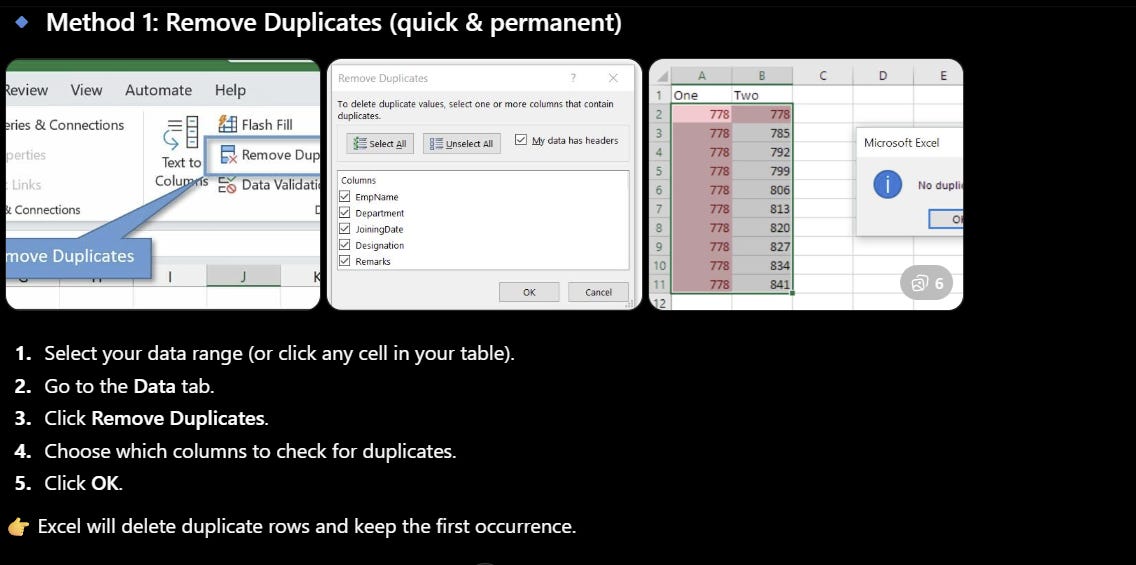
How to remove duplicate rows in Microsoft Excel. I had a large spreadsheet of all of my borrower names at the bank, with each row representing a different loan. But what I actually needed was just the borrower names, and if a borrower had more than one loan with us, each loan had its own row, which led to a lot of duplication in the report. This ended up being a very easy fix, I just didn’t know where to find the correct tool to do it in the busy and jargony Excel ribbon at the top of the page. The instructions from ChatGPT were clear, however, and it took me about 30 seconds to figure out from here. Below is a screenshot of exactly what it showed me:
What the calculations were to convert Canadian dollars into U.S. dollars. And then, how to move money from a Canadian bank account into a U.S. bank account, but also how to move money from a U.S. bank account into a Canadian one.
What the NAICS code might be for a particularly complicated business (each industry has a distinct six-digit code that banks report as part of their lending data. It helps the banks, and their regulators, to have a sense for how heavy they are in certain categories of lending). Most of the NAICS codes are pretty easy to identify: full-service restaurants, 722511. Rental properties, 531110. Hotels, other than casinos, 721110. But what about a physician in a very unique medical care area? I literally loaded this doctor’s website URL into ChatGPT, asked what the NAICS code was, and got the answer.
Making a small change on a graphic I was using. Interestingly, ChatGPT asked me if I had the trademark rights to the graphic before making the change for me, and when I confirmed that I did, the program made the change almost instantaneously.
The other thing I generally use ChatGPT for is casual answers and discussion around questions that I might have taken to a CPA or attorney in times’ past, but that don’t quite rise to the level of needing true professional help (at least not yet). I suspect my CPA and attorney wouldn’t have even wanted to get bogged down in these relatively minor questions, so while they may have lost some billable hours (or billable increments of 15 minutes of time, anyway, in responding to me), I suspect they also will not miss this type of work if customers are able to handle a lot more of their housekeeping inquiries and low-level tasks themselves with the support of AI.
But my point is this: using AI to help with every one of the tasks above saved me time, money, and just as importantly, frustrations. I hate trying to figure things out in Excel, for example. I probably could have searched the taskbar in Excel and figured it out eventually, or Googled it and then interpreted the steps from some Microsoft-sourced website it pointed me to, but neither of those options were as simple as typing into ChatGPT, “How do I remove duplicate rows in Excel,” getting a clear answer with visuals instantaneously, and then executing it myself. It was 45 easy seconds versus 5 frustrating minutes, and if you’re a busy person with a lengthy to do list like I generally have, saving the net amount of time in that exchange and keeping your brain fresh for other tasks is actually worth quite a lot. And with apologies to the graphic design workers out there, being able to edit a logo myself in two minutes for free saved me perhaps several days of waiting and back-and-forth with a graphics person and perhaps several hundred dollars of expense (that being said, quite charmingly, citizens of Newburgh, Maine this past week did reject a logo change for the town because it was generated by AI, and they wanted something done by an actual human who lived in the community). Plus the AI logo also had mistakes in it. Per the Bangor Daily News:
The proposed Newburgh logo shows a pine tree, barn, cropfield and the date the town was incorporated. The AI-generated logo seems to be based on the town’s current logo, which also has a field, barn and Newburgh’s incorporation date. But the proposed branding has mistakes in it. The “I” in incorporated is written with the number 1, while the 1s in 1819 are upside down.
Oops.
If the rosy tone and warm temperature in this week’s article about our AI prospects as a species felt jarring to read, please do stick around for Part II, as there is another side of the coin to the optimistic outlook. In Part II, we will look more at the labor market, more at our brain chemistries, and peer down the road this all intuitively feels like it could go down, which is one with seismic tectonic shifts in our economic and social orders, and the possibility of true instability leading to nothing short of revolution. So stick around, we’ll be right back.
Ben Sprague lives and works in Bangor, Maine as a Senior V.P./Commercial Lending Officer for Damariscotta-based First National Bank. He previously worked as an investment advisor and graduated from Harvard University in 2006. Ben can be reached at ben.sprague@thefirst.com or bsprague1@gmail.com. Thoughts and opinions here do not represent First National Bank.
Asking whether our AI future is positive or negative is the wrong question in my opinion. The problem to solve is the transition between present and that future.