
The Potential for Falling Home Prices in Three Data Points


I was deep in the data this week, and while I was there, I happened upon three different data points that, when taken together, could foreshadow some real downward pressure on home prices. This would provide welcome relief to beleaguered buyers who feel priced out of the market after the significant rise in prices from 2020-2024, while offering some dose of caution for would-be sellers. If you’re thinking about selling, is this the time? Perhaps, if you believe what the data may portend. Let’s dig in:
New Home Sales
We’ll start by looking back to January. The start of the year is typically a slow time in the homebuying and home construction seasons, but this January was even weaker than normal. On Thursday of this week, the U.S. Census Bureau released its report on new single-family home sales in the month of January (note: new homes means just that, newly constructed homes. There is a separate dataset for existing home sales. Both are worth monitoring).
The number of new homes sold in January was 587,000 on a seasonally adjusted annualized basis (note: seasonally adjusted and annualized means they are adjusting the numbers to account for the typical seasonal changes, and the 587,000 number is more of a “pace” for the year and not the raw number of actual transactions; these adjustments are meant to allow for the comparison of the state of the home market between say, January and July).
The January new homes number was low — really low. In December, new home sales on a seasonally adjusted basis were 712,000, so the January number of 587,000 was a drop of 17.6% month-over-month. You might expect to see the number decline due to normal seasonality, but not when both numbers are already adjusted for typical seasonal changes. The number of new home sales one year ago in January 2025 was 662,000, so the January 2026 number was also lower than that to the tune of about a 15.6% decline.
New home sales have not declined because there are fewer new homes available, either. In fact, according to this same Census report, the number of new homes for sale in January was up, albeit modestly, 0.4% from December to January. It was also up 4.0% from January 2025 to January 2026. In other words, there are more new homes for sale, but significantly fewer sales.
The sales data for existing homes for sale has been similar in recent months to the data for new home sales. Per the National Association of Realtors, the number of existing home sales on a seasonally adjusted annualized basis in January was 4.27 million. But in January? The number was down to 4.02 million, a drop of 5.9%. A preliminary report for February shows a modest bounce back to 4.09 million existing home sales (again, seasonally adjusted and annualized), but those numbers are still pretty low.
Mortgage Applications
The drop off in home sales is reflected in another data point, as well, this one from the Mortgage Bankers Association (MBA). Per this week’s MBA report via Trading Economics, home loan applications are down:
US mortgage applications dropped 10.9% in the week ending March 13, 2026, marking the sharpest decline since September 2025, as borrowing costs climbed to their highest level since late last year and dampened refinancing activity. The average rate on 30-year fixed mortgages with conforming loan balances up to $832,750 rose by 11 basis points to 6.30%. Rising Treasury yields, partly driven by elevated oil prices and inflation risks linked to the Middle East conflict, pushed mortgage rates higher across the board.
It should be said that one caveat to the bear case here is that the 10.9% decline represents refinance applications and new purchase applications. Refinance applications were particularly dismal in the early part of March, which is largely a reflection of interest rates; when interest rates rise, it makes less sense to refinance. Purchase applications were essentially flat, which is not ideal for a thriving housing market, but it’s not as dismal as the 10.9% drop-off may sound, which, again, was largely driven by a notable drop-off in refinance applications to banks and mortgage brokers. Still, though, as we enter the spring buying season, you would expect purchase applications to be rising. The fact that they are not suggests the spring buying season could be a bit more muted than usual.
Interest Rates
Lastly, as noted in the MBA report above, interest rates continue to be a dampener on home activity. The average 30-year fixed rate per Mortgage News Daily started the month of March at 5.99%. It closed the week on Friday at 6.53%, which is a pretty sharp jump in just three weeks. The recent rise is evident in the chart below, which shows rates over the past year (the blue line is the Mortgage News Daily dataset, which is based on their own surveys, and the orange line is Freddie Mac data; the two sources have slightly different methodologies, but the data correlates quite closely):
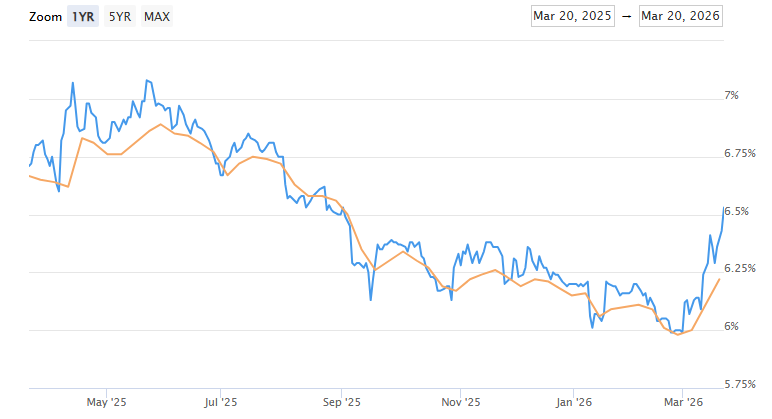
I wrote last week in the context of the Iran War about why interest rates are rising, so I won’t dwell too much further on that today, other than to say in the past week nothing has really improved. A swift and/or decisive end to the war seems unlikely. That is why interest rates have continued to rise. Due to inflationary pressures, markets are now betting there is about an even chance that the Fed will actually hike interest rates as compared to cutting them this year, per Reuters.
What It All Means
Admittedly, I’ve written about the likelihood of price drops in the home market over the course of the last few years several times, and there hasn’t been a sharp drop-off yet (although I’ve never predicted a crash, but more of a deceleration and an easing down). It has taken longer than I thought it might, but I believe the easing has begun. In fact, that same Census report on the new home sales referenced above makes note that the median sales price of new homes sold in January was down 4.5% from December, and down 6.9% year-over-year from January 2025. The existing home sales data shows a similar, although slightly more muted, easing down in prices. This may not be the case in every market as local conditions matter a lot in the price and demand for homes, but prices are certainly not rising the way they did from 2020-2024. The median home price in January 2025 was $429,600 and the median price in January 2026 was $400,500, which is not an insubstantial change to the good for buyers.
Prices rose significantly from 2020-2024 as a basic symptom of roaring demand and limited supply. But what has happened in the past two years? Supply has stabilized due to increased inventory from the construction of new homes and the listing of existing homes for sale, and demand has notably declined. Now that supply is higher and demand is lower, it should result in lower prices (a basic principle of Econ 101). Practically speaking, that will come through things like price concessions from sellers who need to get their homes sold and incentives and discounts from builders to attract buyers for newly constructed homes. I think we can expect price declines of 10-15% throughout 2026. Again, this may not be the case in every market, but based on nationwide averages, I think prices will continue to ease down.
If you are thinking about selling, and provided you have plans on where to go, this is probably a good time to make the move. Inventory may continue to increase and as long as rates stay elevated, buyers are likely to stay on the sidelines. Increased competition from other sellers as homes get listed and stay on the market for longer could lead to further price reductions.
What Will Get Buyers Off the Sidelines
Two and a half years ago, I published an article entitled Homebuyers are Giving Up, in which I wrote:
Home ownership is a fundamental tenet of the American Dream. It not only provides stability in where one lives, but it also helps to build equity and wealth, wealth that is often shared and passed on between generations. If ladders to this aspect of the American Dream are not available to younger Americans today and those looking to purchase their first home in general, it raises the fundamental question about whether the dream is even attainable. For the next year or so, the situation for would-be homebuyers is not likely to improve, which has many simply giving up while they wait things out.
Some time has passed since that August 2023 article, and would-be buyers are still on the sidelines. This is even as buying conditions have improved, with interest rates down from their 2023 highs (despite the move higher in the past three weeks). Wages have outpaced inflation, on average, over the past two years, too, so in theory buyers should be feeling more financially secure.
It is my belief that buyers are on the sidelines not because of the acute conditions of the housing market, but because of their own sense of financial insecurity. People are hunkering down. The general sense that AI could spell doom for countless jobs and industries, lingering financial stress due to rising prices and lagging inflation, and overarching uncertainty with the state of our politics and now the Iran War: it has people pulling back on spending, including both discretionary things like eating out and travel, but on big life purchases like a home.
I do not think we are due for a major housing collapse a la 2008, however. The underlying conditions in the economy and specifically with regard to homeowner health are comparatively stronger than 2008. Delinquency rates on home loans continue to be very low and homeowners generally have a lot of value in their homes relative to what they owe, which is a major difference from 2008 (although that could change if home prices do drop in a significant way).
This latter topic of homeowner health is probably a topic worth of its own separate article at some point, in part because it does speak to the K-shaped economy phenomenon — it’s very hard for people getting started out to get into the home market, but those who are already there are generally pretty secure and stable.
Ultimately buyers will come back to the market once interest rates stabilize and, ideally, drop. And further, once they start to feel more economically secure. If prices for new and existing homes-for-sale come down, which I expect they will in the year ahead, it will also lure buyers back into the market, and we will go through another cycle of adjustments to supply, demand, and prices as things evolve.
Ben Sprague lives and works in Bangor, Maine as a Senior V.P./Commercial Lending Officer for Damariscotta-based First National Bank. He previously worked as an investment advisor and graduated from Harvard University in 2006. Ben can be reached at ben.sprague@thefirst.com or bsprague1@gmail.com. Thoughts and opinions here do not represent First National Bank.