
The World Cup and Sports Diplomacy


One of the more interesting World Cup trivia questions is the question of where the first World Cup took place. The first tournament was in 1930, and for all the rich soccer history throughout Europe and elsewhere, the first World Cup happened not in England, France, Spain, or Italy, but in the country of Uruguay. Not only that, but Uruguay was the first champion. It may have been a bit of home field advantage (travel to Uruguay was somewhat challenging in 1930, I’m sure), but I was fascinated to know in researching this week’s article that Uruguay was actually the dominant soccer power of the day in this era; the country won the gold medal at the Summer Olympics in 1924 in Paris AND in 1928 in the Netherlands. So shame on me for doubting the legitimate claims of Uruguayan historical soccer greatness.
There were some other specific reasons why Uruguay was chosen to host the first World Cup, which makes their selection all the more legitimate. First, the year of 1930 marked the 100th anniversary of the Uruguayan constitution. Second, the government agreed to not only build a new stadium for the event, the Estadio Centenario (Centennial Stadium), which still exists today, but also covered the travel costs of all of the teams that attended. The Estadio Centenario is, to this day, the only soccer stadium named by FIFA as an “Historic Monument of World Football,” a distinction awarded to the Uruguayans in 1983.
The reason I went down a Uruguayan rabbit hole this week was that I wanted to understand why the World Cup was created. It turns out, the driving force behind the formation of the world’s most significant sporting event was a French attorney named Jules Rimet, who championed the creation of the international soccer championship in part to bring countries together to promote “peace and fraternity,” (very similar to the motivations behind the creation of the modern Olympics). He envisioned a tournament in which "men will be able to meet in confidence without hatred in their hearts and without an insult on their lips." And so it has (mostly) come to pass.
The Power of Sports Diplomacy
Sports have often been envisioned as a substitute battleground between otherwise warring parties, which can compete with one another on the playing fields, courts, rinks, tracks, and pools rather than on actual battlefields. History offers some remarkable examples of sports serving as a bridge between bitter rivals. In 1971, for example, a chance encounter between American and Chinese table tennis players led to what became known as "Ping Pong Diplomacy," opening the door to President Richard Nixon's historic visit to China the following year and the beginning of a normalization in relations between the two countries.
At the last several Olympic games, athletes from North and South Korea have marched together under a unified flag, providing rare moments of unity between nations that remain technically at war. Also on the Korean peninsula, Japan and South Korea agreed to jointly host the 2002 World Cup, which was the first time two countries shared in the honor of hosting duties (the United States, Canada, and Mexico are similarly joint-hosting this year; the 2030 World Cup will be jointly hosted by Spain, Portugal, and Morocco). Japan and Korea have had historical tensions between themselves, so the 2002 World Cup marked a key moment of cooperation and diplomacy.
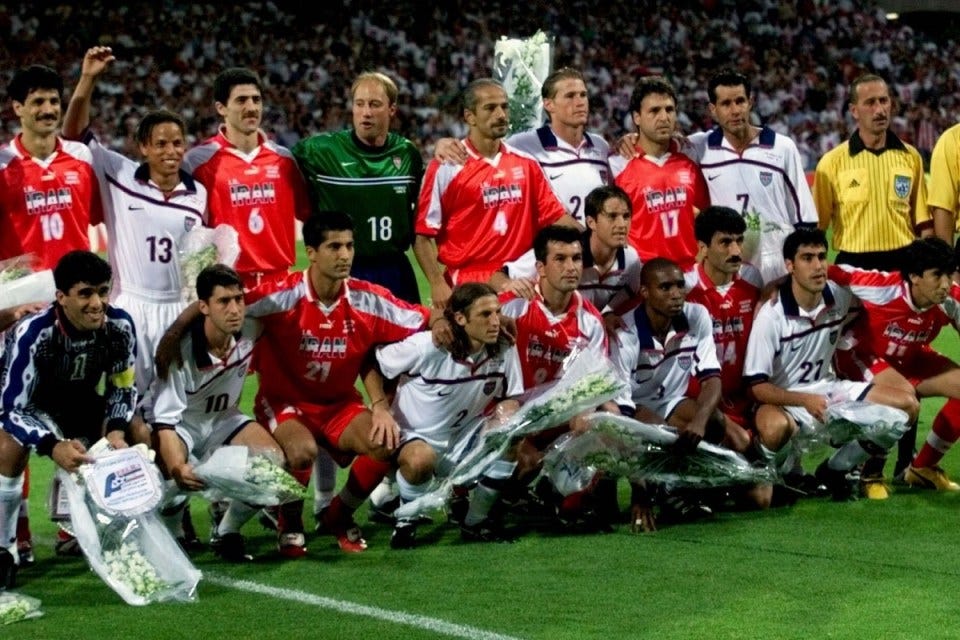
Here in the United States, the Miracle on Ice in the 1980 Olympics is probably the most memorable example of combatant nations (even in Cold War form) challenging one another in the battlefield of sports rather than on an actual one. And in researching this article this week, I also learned about a World Cup soccer match between the United States and Iran at the 1998 World Cup in which players on the Iranian team presented white flowers to the Americans before kickoff as a gesture of peace and goodwill. I’ll be honest, I think I am a fairly robust sports fan, and I am sure I would have actually watched that World Cup matchup in 1998, and I had absolutely no knowledge of this gesture until reading about it this week.
Perhaps the earliest modern example of sports diplomacy was the Christmas Truce of 1914, in which perhaps 100,000 soldiers along the Western Front shared a spontaneous ceasefire over the Christmas holiday up and down the line, with soldiers from Germany and Britain cautiously meeting one another in no man’s land and sharing gifts of cigarettes and supplies and, yes, playing soccer with one another. After military leaders on both sides condemned the interactions thinking it would lead to reduced morale, no similar exchanges took place for the rest of the war, at least none that have lived on in the historical record.
So what does it all matter? Well, what I thought about writing about this week was the vast economic impact of the World Cup. FIFA president Gianni Infantino recently said, "A World Cup is 104 Super Bowls in one month,” which he was basing on viewership and consumer spending. The hundreds of thousands of visitors (maybe millions?) to the United States, Canada, and Mexico for this year’s World Cup will collectively spend billions of dollars on their tickets, travel, meals, etc. Various companies will similarly spend hundreds of millions of dollars just to be associated with the World Cup. I can say from our own family’s experience, we have been to McDonalds three times in the past two weeks so our 12-year-old can try to collect all of the World Cup collectible McDonalds cups. So the World Cup is not just the world’s most important sporting event, it is also one of the world’s most important, albeit temporary, economic drivers.
But I think more importantly than that is the sentiment that this year, perhaps more than ever, the world has just needed this World Cup — the United States, in particular. There are a lot of reasons for negativity out there, but this particular World Cup has been fantastic.
Among the key storylines is that traditionally underrepresented countries have done especially well. Cape Verde, for example, with a population of just over 600,000, emerged from a group that included Spain, Saudi Arabia, and Uruguay to advance to the knockout round (multiple Uruguay references in the same SMP article, a first for sure!). This is immediately the biggest sports story in Cape Verdean history.
Morocco, Senegal, and Egypt all advanced too, marking a great World Cup for the nations of the continent of Africa. Bosnia and Herzegovina also advanced out of its initial group for the first time ever; the country will play the USA this Wednesday. And speaking of the United States, it has been arguably the nation’s best World Cup ever with two decisive victories and then a close loss Thursday evening in a game that did not actually matter much as the U.S. had already clinched its advancement. If the U.S. wins on Wednesday against Bosnia and Herzegovina, this will probably be considered the top U.S. men’s team in World Cup history.
Lastly, one of the special things about this particular World Cup is the stars have shined. Lionel Messi scored five goals in two games. Kylian Mbappé for France has scored four. Erling Haaland for Norway has matched Mbappé, and all three stars’ teams have advanced to the knockout round. Newer faces have also emerged including some from the U.S. team, but it’s been a great World Cup for the most well-known (and marketable) soccer stars from around the world.
What it All Means
So, the world needed this. By all accounts, this particular World Cup has gone exceedingly well. The United States is overflowing with charming stories of international fans being met with a warm and welcoming spirit, much to the surprise of many of those visiting a country they thought might be antagonistic to themselves as international visitors. In exchange, Americans have been similarly smitten with our international guests. A new love between Scotland and the people of Boston has formed, for example, with the Tartan Army, as they are known, virtually overtaking the city to the delight of locals. Stories abound of European fans discovering Buc-ees convenience stores and Waffle Houses throughout the American south. Of the historic Lionel Messi hat trick in the first round of the World Cup, a performance that will likely live on in World Cup lore for generations, it did not take place in a powerhouse media market like New York or Los Angeles, but right in the heart of middle America in Kansas City, Missouri, the self-proclaimed soccer capital of America. That one game is probably already one of the top historical moments in Kansas City sports history.
For the most part, the games have avoided politics. This was not necessarily the case in the lead-up to the World Cup, with the FIFA president becoming abnormally close with President Trump and creating an entirely new award for the president and offering it to him in a cringeworthy press event prior to the World Cup, much to the chagrin of many international fans. President Trump is also reportably set to present the trophy to the winning team on July 19th, which breaks with tradition and also opens him up to a true Bronx welcome (i.e. lots of boos) if he does present the trophy at MetLife Stadium in New Jersey to the winners.
FIFA itself is not without criticism, having a sordid history of awarding the games to nations under questionable circumstances, including the much-maligned decision to give the games to Qatar, a nation with very little soccer history, with the games to be played in the middle of the scorching summer. The World Cup that year was eventually moved to November, and the stadiums were air-conditioned, but FIFA still absorbed significant criticism including from the fact that it was very difficult for fans to travel to Qatar.
In addition, the event has been marred by travel restrictions deemed by some to be excessive for players and referees from countries deemed to have exposure to the Ebola virus, and on the Iranian team itself, which was notably restricted in their travel arrangements given the current conflict between the two countries. The Iranian team responded, in part, by leaving a handwritten note in their locker room in Los Angeles after their game thanking the city for their hospitality and saying, “May peace, respect, and friendship prevail among all nations.”
But the event has been positive overall. I have no doubt that this year’s World Cup in the United States (and Mexico and Canada) will have ripple effects for the next generation or more on American youth soccer. I know my own son has been gripped by the games, watching virtually all-day long and engaging with absolutely any matchup that is on. I liken it a bit to the impact of the USA Dream Team men’s basketball team at the 1992 Barcelona Olympics, which boosted basketball not only in the United States but around the world. I think you can trace much of the surge in international basketball particularly in places like Spain, France, Italy, and the nations of the former Soviet Bloc to that 1992 American team. The impact of this year’s U.S. men’s soccer team will boost youth soccer for a generation or more to come, much in the same way that the U.S. women’s team has done over the past several World Cups on the women’s side of things.
Unfortunately the World Cup will end in three weeks, and, indeed, the world will keep spinning. It should be said that the joy that so many fans have felt at watching this year’s festivities is no comfort to the countless people around the world living under the threat of violence, death, and despair. So I do not want my buoyant thoughts on sports diplomacy today to create the impression that all is well in the world, even momentarily so. A hat trick by Messi and the surprise advancement of the Cape Verde team, for example, does nothing to help the migrant in the Mediterranean, the mother in sub-Saharan Africa dealing with drought and disease, the grandparent in Ukraine caring for their orphaned little ones, or, indeed, the single parent in Appalachia here in the United States struggling with the high cost of living.
But hopefully the games at least bring a moment of entertainment and excitement, and a fleeting sense that there are still positive moments that can bring people around the world together. Sometimes symbolism does matter, and cross-border battles on the pitch are far better than armed conflict, drones, bombs, and economic strife. May we all carry the spirit of this year’s World Cup forward in our own ways, big and small.
Ben Sprague lives and works in Bangor, Maine as a Senior V.P./Commercial Lending Officer for Damariscotta-based First National Bank. He previously worked as an investment advisor and graduated from Harvard University in 2006. Ben can be reached at ben.sprague@thefirst.com or bsprague1@gmail.com. Thoughts and opinions here do not represent First National Bank.