
What It's Like to Write in the Age of AI
Or, why I've come to hate the em-dash


The year 2026 will be remembered for many things, one of them being the continued rapid rise of AI. I think November 30, 2022, which was the date ChatGPT launched a free preview version of itself to the public, will be remembered in the history books as one of the true inflection points in human progress. The ChatGPT app gained one million users within five days of its launch and 100 million users within two months, making it the fastest growing new form of technology ever. Today, over one billion people use ChatGPT weekly, making it the largest AI assistant tool out there. That means roughly one in ten people around the world is using ChatGPT each week. And that’s not even counting other AI assistant tools like Claude and Gemini, which likely boast a combined billion users per week between them (with some overlap among people who use multiple tools).
I want to pause with an acknowledgement that I owe you all, the readers, Part II, in my previously planned AI series. You can read Part I: the Dove Case on AI, from May here. The failure to publish Parts II and III weighs heavy on my Substack-writing heart. The truth is, I have been professionally scraping the edges of what I am capable of this summer (all with good things, though!), and I haven’t been able to devote myself fully to that very important second article. It’s coming, though. More on all of this soon.
The fundamental ways AI is shaping and changing the ways we humans do all sorts of things is the story of our times. One of these human endeavors that is being changed is writing, and as a writer myself, I’ve been experiencing and observing these changes pretty directly.
I am glad I started writing this Substack series in April 2021, a year and a half prior to the November 2022 inflection point, for two reasons. First, had ChatGPT and all the others existed at the time when I originally had the idea to start a weekly article series, I probably would have just….not done so. It would have been too easy to lean into the AI of it all. Admittedly, one of my own long-term worries I have in continuing to write these articles is that AI writing and research is getting so good, it could soon feel like what is even the point of writing these articles myself. If ChatGPT can compile, synthesize, analyze, and organize thoughts better than I can, why even bother?
Yet as I wrote about awhile back when discussing the reasons I continue to write The Sunday Morning Post, two of the main ones were 1) to keep my brain fresh, and 2) because I like the puzzle-solving aspect of dissecting a good topic and putting together something that others will want to read and digest themselves. I also like the endorphin rush and sense of accomplishment of finishing an article and scheduling it to post at 6:00 am every Sunday morning.
The second reason I’m glad I started when I did is that I have almost two years of demonstrated content that I can point to as having been written prior to AI being so widely available. I feel proud that I can point to pre-AI work as evidence that I can actually write a thing or two, and that these articles are not AI-generated. In fact, I’ve seen criticism of other writers who have started more recently, whose entire corpus of work is questioned by others simply because they do not have any pre-AI work they can point to as legitimately done by themselves.
I do feel like as time goes by, people will have an increased appreciation for independent voices who write in their own unique styles. “Hand-crafted articles,” is a tagline I have sometimes thought to use for The Sunday Morning Post, which could resonate more as time goes by as more and more of our writing (and therefore, our reading) melds into AI’s style.
What Writing is Starting to Look Like Now
It’s easy to think of AI assistant tools like ChatGPT as being able to “think,” on their own, and maybe a true technologist would say that yes, in fact, this is what they are actually doing through the processing of information and the output of synthesized thoughts. Who knows. At their core, however, these programs are essentially analyzing massive amounts of data almost instantaneously and using predictive models about how different words and phrases could and should go together.
But the output has a sameness to it. There is “ChatGPT voice,” if you will, and once you understand it, it will become almost impossible to ignore it and simultaneously insufferable to see it deployed in the real world as ubiquitously as it being done so today in all manner of communications, personal and professional alike. I routinely see what I am sure is AI-written content in all aspects of my professional life. It comes in emails from colleagues and clients, in responses to inquiries on customer-service related questions, and in other newsletters and general updates. I see Facebook friends posting entire lengthy status updates that are clearly not in their own voice, but are almost surely ChatGPT-written.
Is this a bad thing? Well, it’s complicated. More on that below. But before tackling that question, let me share the key tells that tip me off as to whether something has likely been written by AI, particularly by ChatGPT:
A sterile, corporate-feel of a tone that is overly polite and lacks emotional warmth. Emotions are part of what makes us human. ChatGPT has gotten pretty good at nuance and is even pretty clever with witty insights, but it hasn’t mastered the complex, meaningful conveyance of human emotions within writing. If something feels bland or just lacking some punch, chances are it’s AI.
Excessive use of em-dashes (i.e. long hyphens between thoughts and phrases, often used to expand thoughts or to introduce new ideas). About 2-3 years ago, I started using ChatGPT to proofread all of my articles (as well as many other things I write, like complicated or important emails and professional messages to colleagues and clients). I noticed that the program was not just finding typos and grammatical errors, but it was also suggesting the insertion of em-dashes all throughout my writing. At first, I didn’t pay much mind to this — there is often a place for an em-dash, and it can be a useful grammatical tool. But they started to take the place of almost every semi-colon and colon, and a lot of commas, too — it really just became too much. If you see an email, a paragraph, or an article with a lot of these long hyphens, there is a good chance it was either written or edited by ChatGPT. In fact, I would love to see a study of pre-2022 writing and post-2022 writing for a comparison of the use of em-dashes. Whoever designed ChatGPT was fond of the em-dash, and it has now become ubiquitous throughout our collective writing.
An “It’s not just this, it’s that,” phrase construction. This phrasing is such a core aspect of ChatGPT writing that I groan almost every time I see it now in professional writing. An example might be, “Planting the garden wasn’t just about dirt and seeds — it was about time spent together and memories that grow from the ground up.” Or, “Running a half marathon wasn’t just about the steps on the pavement — it was about the steps she was taking in her life.” Or, “The school play wasn’t just about Shrek and Donkey — it was about a community coming together at the moment they needed each other the most.” None of those sentences are bad per se, it is just when you start to see this type of sentence construction pretty frequently, it becomes exhausting. It’s not just that it’s bad writing — it’s that it feels lazy, too.
Pristine grammar and clean, overly structured sentences. This is a tough one for me to describe, especially as someone who values and appreciates error-free writing. I have noticed when I ask ChatGPT to fully proofread an article for me, what it gives back to me sounds basically like me, but it’s not me. It’s me as if “me” were being played by an actor in a show. When I read my own writing that has been proofread and edited by ChatGPT, I feel like I am reading a slightly-off version of myself, one that is actually more grammatically precise and better organized in their thought conveyance, but with something that is just not quite my authentic self.
Much of the above might sound like sour grapes. “You’re just mad as a writer that other people are now writing better themselves,” some might say. “Isn’t it better, in general, for writing to be typo-free and grammatically accurate?” Yes. But what I think people tend to value, as well, is authenticity, and this fluffy, pristine, tepid, corporate tone that so much AI-language is employing today feels the opposite of that.
I actually think the pendulum is swinging towards writers who are a little messy. Maybe that comes from a typo or error or two, but more positively, it comes from having a unique voice that maybe has some sand in the gears in certain ways but comes across as authentic, refreshing, and real.
The risk for professionals using ChatGPT to excess is that they are losing their own voice, and perhaps also their own ability to synthesize thoughts and create thoughtful content. And when there are people who can tell what is AI writing and what is not, they risk a credibility gap if it is believed by others that they are leaning too hard on the tools and not on their own thoughts.
So, What Is the Future of Writing?
Back to the question about whether these trends in writing are good or bad. I’ve said this before, but employing AI as a tool for many people in their writing and with their communications as a whole is entirely a good thing for them. Being able to use ChatGPT to proofread, fact-check, and even craft entire emails, memos, or articles, helps many people who are slow writers or weak communicators to backfill this missing skillset in themselves. It helps many in the middle or the lower tiers of their workplaces to close the gap, and undoubtedly it helps already-good writers to produce content faster and, yes, with more accuracy. Truth be told, I use ChatGPT all the time as a research assistant and, truly, almost like a thought partner in various aspects of my professional life.
And proofreading is actually important. Typos and grammatical errors undermine the credibility of a piece. I cringe every time I see obvious errors in a newsletter coming from what should be a trusted institution, such as my kid’s school or something like that. And believe me, I recognize my own shortfalls in this area. This is coming from someone who wrote a sentence in last week’s article talking about how my friends who own a brewery here in Maine are brewing great bears. But with such easy proofreading tools out there, it, to me, ratchets up the magnitude of errors.
On the question of the future of writing, we can look to college and high school classrooms for some clues. Professors and teachers seem at a loss for how to deal with the ease and ubiquity of crafting comprehensive and well-organized papers using AI. They may be able to identify what has been written by AI from many of the same tells I shared above, but what are they then supposed to do with it? It’s a gray area. Some college professors are requiring students to do their writing sitting in an actual classroom over the course of two or three hours, separated from their AI crutches. That may work for open-response test questions or even short essays, but lengthy term papers or any type of more comprehensive analysis can’t be done in the time it would take to complete an in-person exam.
Regrettably, I think the art of writing may be on the decline. It’s just too easy to produce content using AI at this point, and the tools are only likely to get better. The tells I noted above will probably be washed away soon, and it will be nearly impossible to tell what is hand-crafted versus what is AI-created. Entire books will be written in seconds, grammatically accurate and full of the connections and emotion that are still lacking now in much of this.
But just as relevant in the problem of writing’s future is that we need actual writers. How many young people just coming up in the world are taking the slower, harder, more mentally taxing (yet also mentally rewarding) path by writing out their full thoughts, struggling with complicated ideas, editing, re-writing, editing again, and doing all the wondrous yet time-consuming things that are involved with writing a really excellent thing. I suspect there will not be nearly as many writers as before.
The hope, though, is in the pendulum swing I mentioned above. Perhaps authentic voices will still rise to the top, and that humans can still retain the distinct things that make us human, including the ability to synthesize thoughts, ideas, and emotions and convey them in a way that leaves the reader learning something, feeling something, or motivated to do something. Maybe readers will value authentic voices from people they know are writing their thoughts naturally — organic, writing, if you will. Time will tell (and yes, I couldn’t resist one final em-dash, but this one was my own construct).
Addendum
What may be just as pervasive as AI writing these days is AI graphic design. Scrolling through Facebook or Instagram and seeing event announcements has become exhausting, especially if you are keen to resistance against AI content. It feels like every graphic, every event flyer, and every form of publicity right now is using the same basic template.
I don’t want to single out any of my many friends who are designing their event flyers with ChatGPT, so I’ll do it on my own endeavor: The Sunday Morning Post. The publicity graphic below took me about 10 seconds to create through ChatGPT using the very simple prompt, “Can you design a flyer to help publicize ‘The Sunday Morning Post’ series.” This is what it came up with:
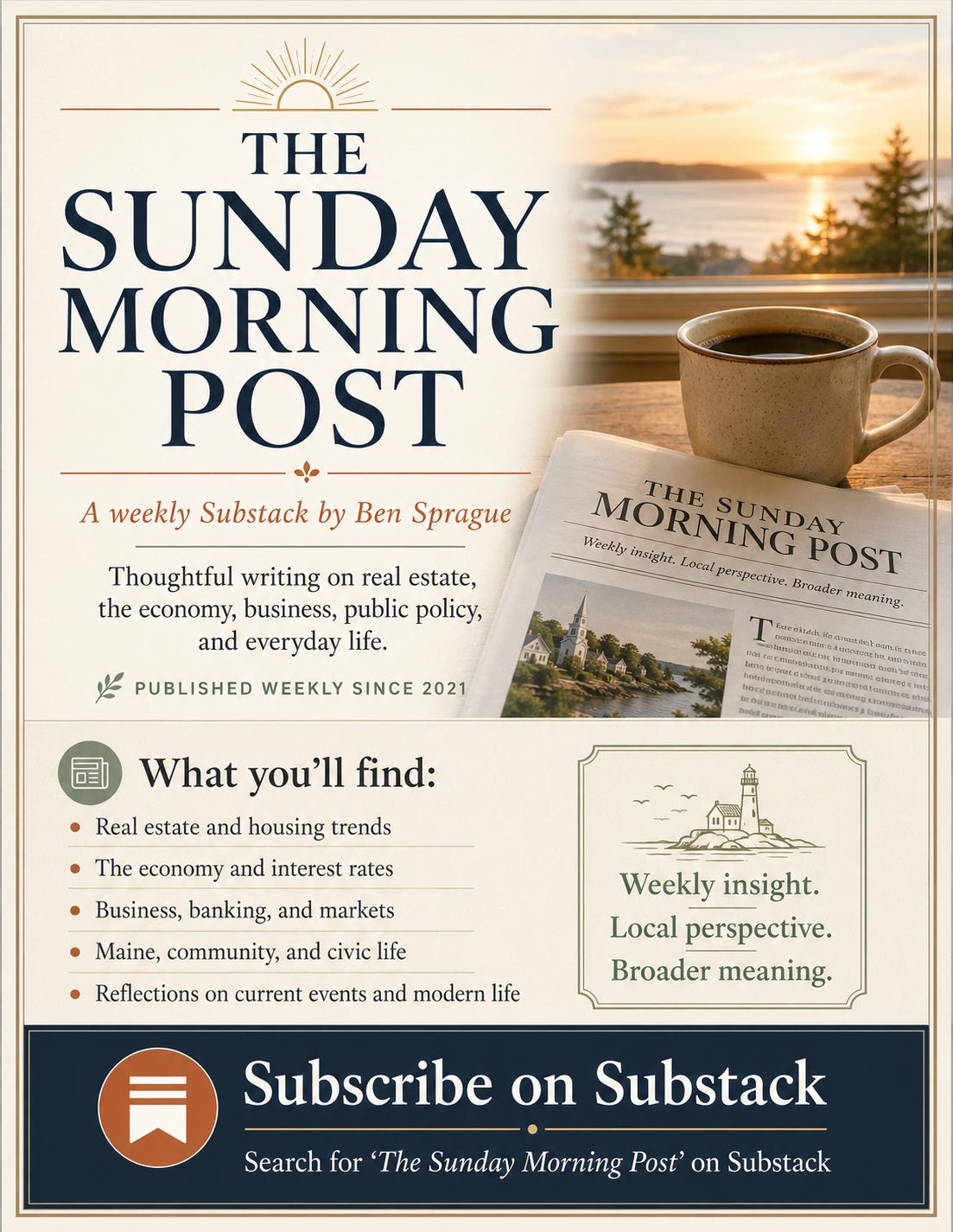
Ugh. I hate that it’s actually good. I couldn’t create that myself if I had 10 hours, a marketing budget, and a deep background in graphic design. And this graphic is actually much less chaotic than a lot of online slop flyers right now, which tend to be a little bit overwhelming. ChatGPT probably sensed that I would not actually like an overly chaotic version of this for my own publication, so it probably anticipated what I would like and what I would not like (I’m not kidding). Anti-chaos also fits the vibe here, which it basically nailed in the graphic above.
At the same time, other than the lack of chaos, the flyer above does look basically like every other publicity flyer out there right now. People are getting fed up with these. It’s the style of the moment (mostly because it is so easy and people can create things that look much better than what they would be able to produce, or could afford to produce, on their own), but I anticipate a sharp pendulum swing into more minimalist graphics or at least something that does not feel as AI-driven.
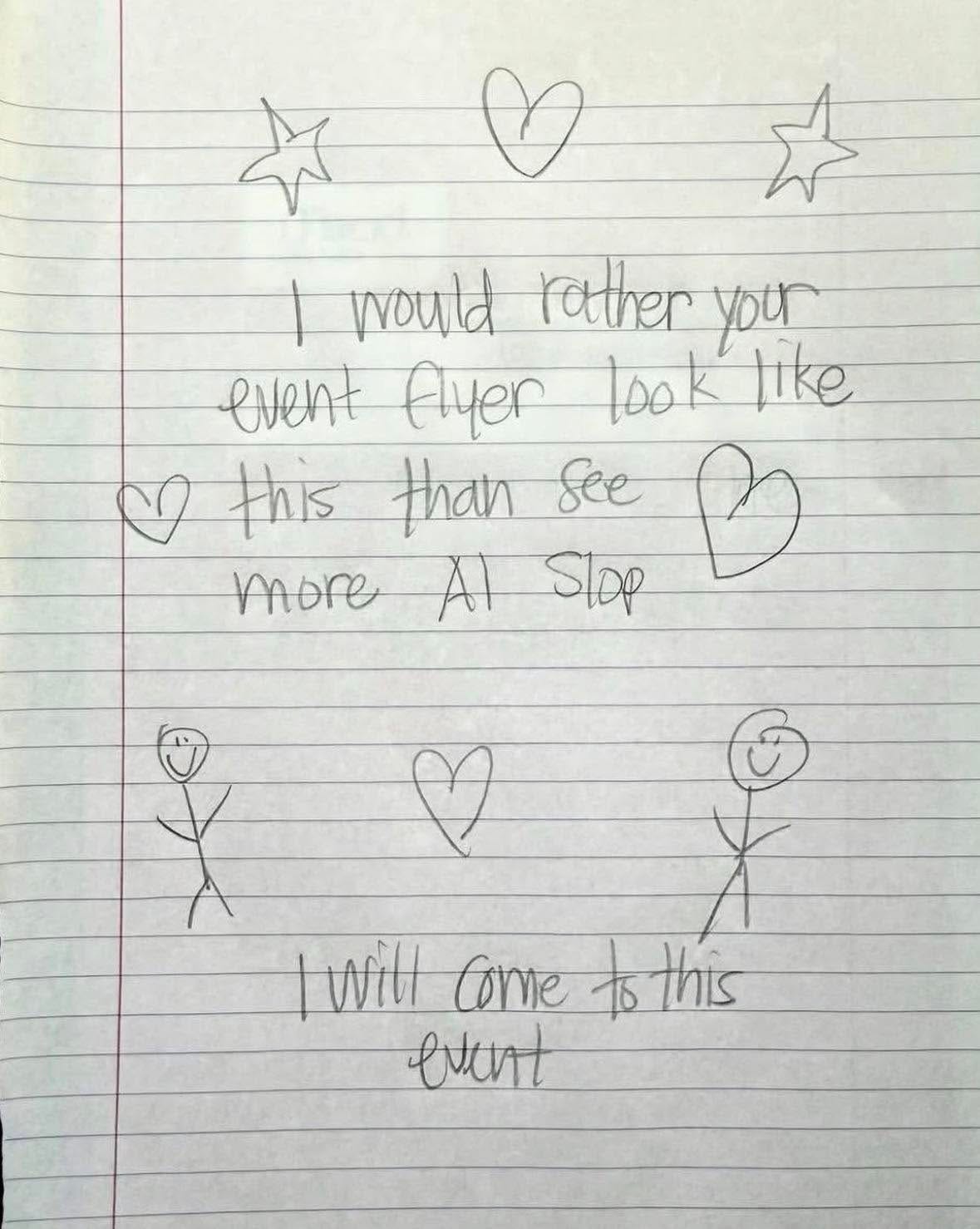
A positive meme I’ve seen floating around Facebook and Instagram in recent weeks is the image below. I don’t know to whom it should be originally attributable, but I like the sentiment and thought it was worth sharing here. If you’re running an event or promoting a cause, keep the spirit of the below in mind, as we are all getting tired of the AI-generated stuff:
Have a great week, everybody.
Ben Sprague lives and works in Bangor, Maine as a Senior V.P./Commercial Lending Officer for Damariscotta-based First National Bank. He previously worked as an investment advisor and graduated from Harvard University in 2006. Ben can be reached at ben.sprague@thefirst.com or bsprague1@gmail.com. Thoughts and opinions here do not represent First National Bank.