

Greetings, readers, and Happy New Year. Today I am sending a special edition of The Sunday Morning Post to offer some updates and a general lay of the land regarding these articles for the year ahead. This is largely a follow-up to a May 2024 article that offered a similar status update and check-in, which you can read here if you are so inclined.
Some of the ambitions of the May 2024 article have been realized, while others have not. Most positively, The Sunday Morning Post beat goes on. By my tally, I have posted an article for 246 straight weeks going back to April 2021. I know “I can’t believe it” is the standard thing to say after declarations like that one, but, well, I truly can’t believe it. April will mark five years of writing. It certainly hasn’t felt like five years, and it hasn’t felt like I have clicked publish nearly 250 times in putting these articles out into the world.
The State of the Post
I love writing these articles and I plan to continue to do so. With all of the above in mind, however, The Sunday Morning Post faces two critical issues if it is to survive long into the future. The first is that I have become increasingly aware that there are two distinct (although probably overlapping) audiences for Sunday Morning Post content. These articles originally began with a primary focus on banking, real estate, and the economy. There was a particular focus on the housing and rental markets early on. A certain portion of Sunday Morning Post readers, I believe, are here primarily for those discussions. And yet, in more recent years (especially in 2025), I have started to write about other topics beyond just real estate, including AI and the future of work.
Does the active real estate investor who came to The Sunday Morning Post in its early days care about these other topics? I think yes, to a certain degree, but it’s also fair to say that the data-centric articles about trends in the housing and rental markets are no longer the exact primary focus of The Sunday Morning Post. I do not want to abandon the reader who is primarily interested in these topics, however.
The inverse is also true. Do the readers who subscribed after reading The Looming Critical Thinking Crisis in August, for example, which was one of my most popular articles of 2025, care about my upcoming rental market preview article for 2026? Maybe. But also, maybe not.
I do think the expansion into some broader topics this year, particularly AI and its impacts on not just the economy but society in general, has been a good thing for The Sunday Morning Post. One can only write (and read) about multifamily construction in the Federal Reserve data so many times before the momentum starts to fade a bit. I think the expansion to new topics has helped to keep things fresh.
What I would really like to do someday, perhaps, is split The Sunday Morning Post into two separate series. One would cover the original topics of housing, real estate, and construction, while the other would cover the more expansive topics like AI, the future of work, and all the “palate cleanser” topics, as I like to call them, like the articles I wrote this year about the marketing campaigns of Coca Cola and The End of Late Night. People could then choose if they want to receive one publication, the other, or both.
That brings me to the second critical issue for the future of The Sunday Morning Post, which is the question of my own bandwidth. There are definitely times when I wonder if I can keep these going. It’s not a question of not wanting to do the writing, it’s about having the time to do it. I will spare you the details of just how busy I am because it will feel indulgent or self-aggrandizing, but suffice it to say, there are only so many hours in a week and I only have enough bandwidth, mental and otherwise, to get everything done. You can call it a side project, a hobby, a gig-economy job, or just a labor of love, but writing The Sunday Morning Post is just one of my many commitments, including family, of course.
All that being said: As of today, the start of 2026, I do not have specific plans or a timeline to stop writing. I may continue forever. But I also may not. I wanted to at least put this on the radar so I can mentally prepare people if The Sunday Morning Post were to someday end. If it does, I will give people advance warning and a full explanation. For now, however, the series will go on!
Let’s Talk Financials
As a good old-school New Englander, I know it’s not polite to talk about money, but I also believe in transparency. I do not have a huge following on Substack. That doesn’t mean I don’t appreciate the readers who do show up here. In fact, I think it makes me appreciate you all even more. But my audience is modest by any account, and it would be a microaudience to some of the largest and most influential writers on this platform.
I think in terms of earning money from writing on Substack, the ones who do fairly well at this are the writers who brought large audiences to the platform with them by virtue of having existing national name recognition or through many years of writing on another platform or with a larger media outlet before coming to Substack. I, on the other hand, started from scratch.
The true value for me in writing on Substack is that it has given me the opportunity to develop my subject-matter expertise, which has undoubtedly been good for my professional career in many ways. I am not compensated by my employer for writing these articles, and yet my doing so is part of the “total package” of having me as an employee, I think, so writing The Sunday Morning Post has been good for my career, for sure. I am very grateful that my employer does allow me to write and publish these each week, that’s for sure.
Apart from that, developing professional relationships and personal friendships with many of my readers over the past 4.5 years has provided many opportunities, financial and otherwise, that are not necessarily quantifiable or definable, but are a part of the total picture of personal and professional development that I have experienced through writing The Sunday Morning Post.
The other value, which I explained more in the May 2024 article, is that The Sunday Morning Post keeps my brain fresh, and requires me to think, study, and puzzle things out each week.
As a reminder, people can read The Sunday Morning Post entirely for free every week. They can also pay to subscribe, which gets them….the exact same package that they could otherwise get for free. Quite a salesman am I, offering people the option to pay for the same thing they can get for free.
Why would I set it up that way, some might ask. There are several reasons. First, I don’t want to write for a smaller audience where the mark of entry is the ability and propensity to pay. I have had a lot of opportunities in life, many of which have developed me into the writer I am today. Keeping the articles free is, I guess, a way for me to pay it forward.
In addition (and this is the truth, too), I have a lot of bank customers who are on my subscriber list, and it feels wrong to ask them to pay me for something that is sort of a blended role with me as their commercial banker. It feels like too much of a conflict of interest to have my bank customers on my weekly subscriber list and then ask them to pay (although, some do, for which I am very grateful).
So what do I actually make in hard dollars for writing The Sunday Morning Post? Let me tell you: this year it was $4,406. Here is the actual data showing the growth in revenue that Substack provides me through my own writer portal. The paid subscription only started in May 2024, which is why there is the leap at that point:
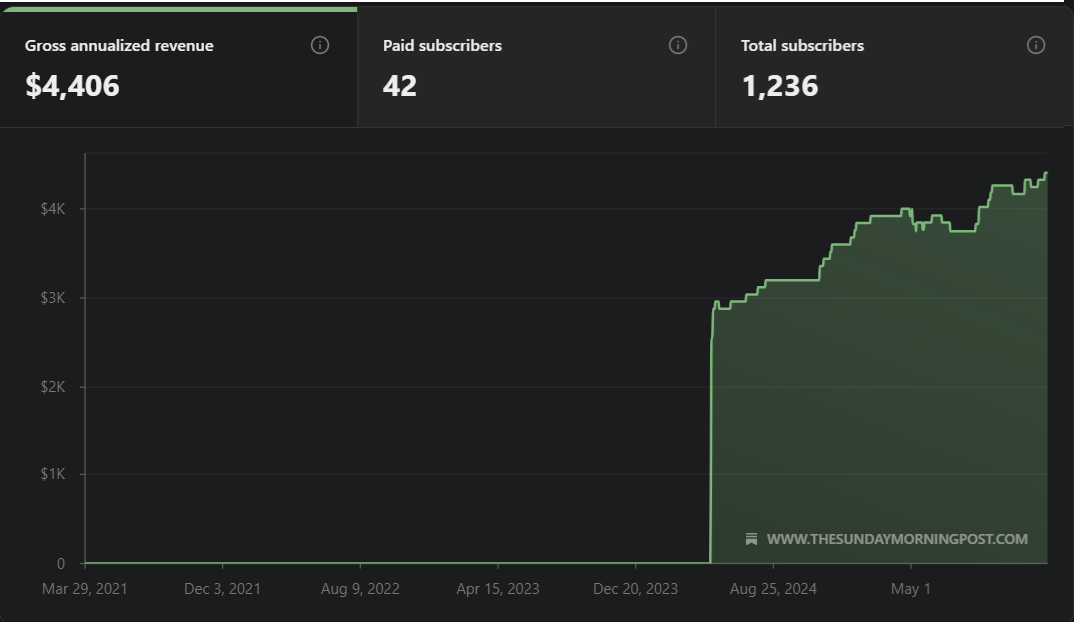
What this data means is that I have 1,236 total subscribers — that is the number of people who get my articles in their inboxes each week — with 42 paid subscribers. In 2025, those 42 paid subscribers paid $4,406 in total. Substack then takes about 10% of the revenues for their own services, which is how they get paid. As a writer, I don’t necessarily think this is a bad deal because I get a lot of value out of the platform, which I find to be very easy to use, but of the gross revenue generated here, about 10% goes to Substack.
These are not figures that I am embarrassed or ashamed about by any means. In fact, I am quite proud of them. The Sunday Morning Post has largely been a labor of love, so to have that many people want to receive it in their inboxes when there is so much other incoming content bombarding them at all times, and for 42 people to say they will pay for something that they could otherwise get for free is actually quite affirming. Many Substack writers would probably laugh at these numbers as especially low, but I share them with you with pride and gratitude. At the end of the day, people pay to receive and support my writing, which is humbling and rewarding in more ways than one.
I will use this moment to say that while earning income from these articles is not my primary motivation, the supplemental income is nice. My pitch today is the same that it was in May 2024:
You will never see any paid ads on this page. The articles are written by me (and not a bot; although the bots do now proofread each week before I post!). The page is clean and clutter-free without any pop-ups, ad banners, and interruptions.
The revenue from paid subscriptions does help to make The Sunday Morning Post sustainable. I do give up some time and bandwidth to get these done each week, and the supplemental income is a nice way to justify the continuation of this ongoing project.
I estimate that I am leaving between $2,000-$7,000 per year of revenue on the table each year by not adding a paywall. Where do I get this figure from? Various sources point to Substack writers who convert from an entirely free publication to a paywalled publication getting about 5-10% of their free subscriber base to pay for a subscription. My 42 paid subscribers in a total subscriber pool of 1,236 readers represents about 3.3% of my readers. If I were to have a paid subscriber base of 5-10% of my free reader list, it would generate an increase in paid subscriber revenue of about $2,000-$7,000 per year. That would have me around $10,000/year in revenue, which would actually be pretty good.
All that being said, I do not want the relationship between me, the writer, and you, the reader, and all of us in community together to be bound by payment. There is a reason I posted exactly one article like this (in May 2024), and then the follow-up is over 18 months later. I don’t want to get bogged down in the money. If not one new person pays to subscribe to The Sunday Morning Post and, in fact, if I were to lose subscribers, I am still going to keep writing. If I have to give this up at some point, it won’t be because I’m not making enough money from it; it will be because I just don’t have the bandwidth between my job, my side work, coaching my kids’ teams, and, most importantly, trying to be a good husband and dad to keep making it work each week.
What Comes Next
I mentioned above that some of the ambitions of the May 2024 article have not come to pass. One of them was to set up a chat community of Sunday Morning Post readers. That has fallen by the wayside for lack of my own capacity to develop and support. If writing these articles was my full-time job and I had 40+ hours a week to dedicate to it, I would love to get something like that going. But it’s just one piece that has not come together, at least not yet.
A second ambition is to have guest writers. I probably could invest some time into bringing on some additional writers, but so far, the potential time saved from having someone else cover a week or two has not felt worth the work of setting up these relationships. I have a pin in this one to come back to it, though, especially if The Sunday Morning Post were to eventually split into two separate series. Writing partners or guest writers could help bolster both series.
For now, however, my most important point to make to you today is that The Sunday Morning Post will continue into 2026. The good thing about writing a Substack series that is not your primary form of income is that I can be creative on the topics. I can go in some different directions. We can try some things and see if they work. For now, however, the beat goes on.
THANK YOU for reading The Sunday Morning Post. Whether you read it first thing Sunday morning or come back to it later in the week or whether you only catch it here and there, I am glad to have you as part of The Sunday Morning Post community. I’ll see you next week with some data on the housing market over the past year and some thoughts on what to expect in 2026.
Ben Sprague lives and works in Bangor, Maine as a Senior V.P./Commercial Lending Officer for Damariscotta-based First National Bank. He previously worked as an investment advisor and graduated from Harvard University in 2006. Ben can be reached at ben.sprague@thefirst.com or bsprague1@gmail.com. Thoughts and opinions here do not represent First National Bank.
If you would like to become a paid subscriber, click here or click to read more here.
Top Ten Post of 2025
Here were the most read Sunday Morning Post pieces in 2025. Thanks again for supporting this publication.
1946 vs. 2026. An article that compared income tax rates in 1946 to today.
The Home Insurance Crisis. An article that addressed rapidly rising home insurance costs, particularly after the California wildfires.
It’s Hard to Tariff a Pencil. An article that discussed how tariffs are very complicated because so many products have many parts and those parts often travel across country lines multiple times before a product is finished.
The Looming Critical Thinking Crisis. An article about how AI is changing the ways we think and undermining critical thinking in schools.
In Defense of Gen Z. An article about how the generations coming of age today aren’t so bad.
Your Banker Doesn’t Work on Commission. An article of several things your banker probably wishes you knew. Note: several people did NOT like this article. It’s probably one of the most and least popular articles I’ve ever published.
Ben’s 2025 Book Recommendations. An article with my top book picks for 2025, and those from my family members. This one is quite high up the list despite only being out in the world for one week at the time of this writing. Score one for the books!
How I Would Futureproof Myself if I Were Starting Out Today. An article about ways to guard against being automated or AI’ed out of a job.
Thoughts on the Stock Market and The Trump Tariffs. An article about the Spring 2025 stock market drop and the impact of the tariffs.
The 2020 vs. 2025 Comparison. An article about the state of the economy, inflation, and the unease many people and businesses are feeling.
The year 2025 was a year of uncertainty, economic and otherwise. The #1 most read article of the year (the 2020 vs. 2025 piece), which was published on April 20th, contained the passage below, which probably best summarized the 2025 year as far as the economy is concerned:
An ongoing theme in conversations I am having with a lot of business owners, investors, and just in everyday talks with people these days is that the world is frozen. Things are on pause. Business owners are not investing in themselves through expansions and new hires because of fears about tariff uncertainty. Real estate investors are having trouble making the math work on acquisitions due to high prices and elevated interest rates, so not as many deals are taking place. People at one end of the spectrum are feeling cash-strapped due to the lingering effects of inflation particularly at the grocery store, while others are feeling anxious after being pounded by stock market losses over the past three months.
What it all means is this: the world is at a standstill. Everyone is waiting to see what happens. This includes banks and others in the financial world, who are suddenly cautious about which deals to finance and which to avoid.
Since I wrote that article in April, an additional theme that emerged was the stock market rebound, which helped contribute to the emergence of the “K-shaped economy,” in which people on one end of the spectrum seem to be getting worse off while others about a certain level are improving. That is likely to be one of the major topics in the overall economy in 2026, and one of the key themes for The Sunday Morning Post in the months ahead.
Ben's commitment to civil dialogue should be reciprocated by the readers who crave it. In this community there are folks willing to post accurate and concise book recommendations, financial news, public budget fiascos and economic history. What we really need to cultivate is a volunteer editor. Accordingly, anybody with such a background and willing to engage the community Ben has cultivated should reach out to the publisher. The discussion Ben has initiated in this forum should persist even when Ben has more urgent commitments - such as his family or career.
Hi Ben,
I have enjoyed all of your articles. I think that your articles have all connected to each other under the theme of "community", which I believe perfectly joins discussions of housing and work. In our smallest and poorest cities in Maine we have many neighborhoods that suffer from disinvestment and we have too few good paying jobs. I read a recent report that stated that the Portland area is the only part of Maine that has significantly grown over the past ten years. Waterville has been fortunate to be the recipient of Colby College's investment in our downtown but we still just had a major hospital close and many homes have lost the big gains in value since the last of the pandemic years. I've thought about writing a substack about the difficulties of revitalizing neighborhoods. Your open letter about the process and business of writing was particularity interesting. And as Dennis wrote, they have all been well written, informative and genuine. Thank you so much for your weekly column and I hope it does continue!